SOCIETY
The World's Urban Majority
2007 CE
History · Contemporary · Holocene · Meghalayan
Around 2007, according to the United Nations, more than half of humanity lived in towns and cities for the first time, the end of a transition begun with the first Neolithic settlements.
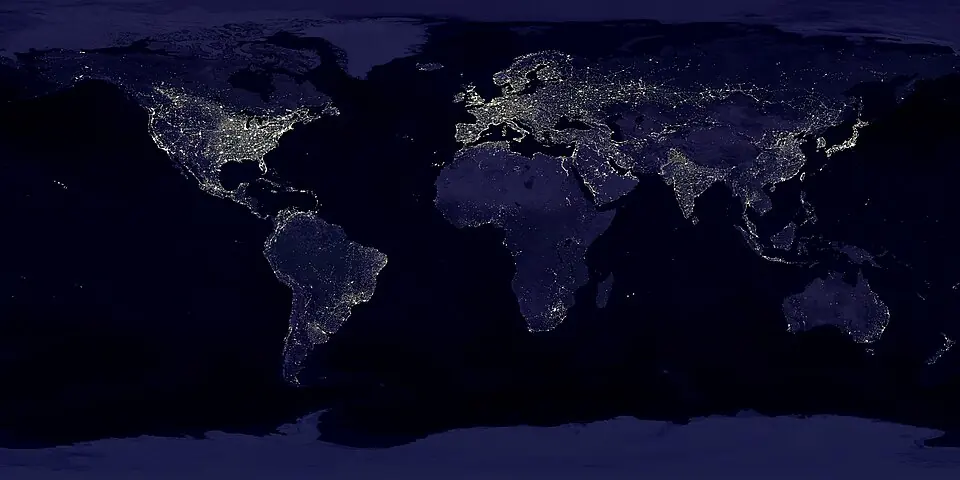
The world population becomes predominantly urban around 2007 according to the accounting of the United Nations Population Division, the term of an urban transition begun with the first Neolithic agglomerations. The figure is conventional: the word city has no international definition, each state setting its own by population, density or administrative status alone, so that the same locality is urban on one side of a border and rural on the other, and the world total adds up heterogeneous definitions. Satellite measurements, which apply everywhere the same criterion of built-up area and population density, give a distinctly higher urban share. The gap between the two results follows from definition and not from measurement.
Why it matters
Cities concentrate about 80 per cent of world economic output and more than 70 per cent of energy-related emissions. Several billion additional urban dwellers are expected by mid-century, principally in Africa and Asia. How the climatic, health and social pressures of this century are absorbed therefore depends largely on the form of the districts being built now.
Dating & uncertainty
The anchor around 2007 corresponds to the crossing of the threshold in the United Nations series. Estimates based on satellite observation of built-up area place that crossing earlier.
Our species’ history as one day
23:59:545.2 s before midnight
if the 315,000 years of Homo sapiens were compressed into a single day