GENETICS × TECHNOLOGY
CRISPR Genome Editing
2012 CE
History · Contemporary · Holocene · Meghalayan
CRISPR, a defence system of bacteria against viruses, was shown in 2012 to be programmable at will, and became a tool that cuts DNA at a chosen place.
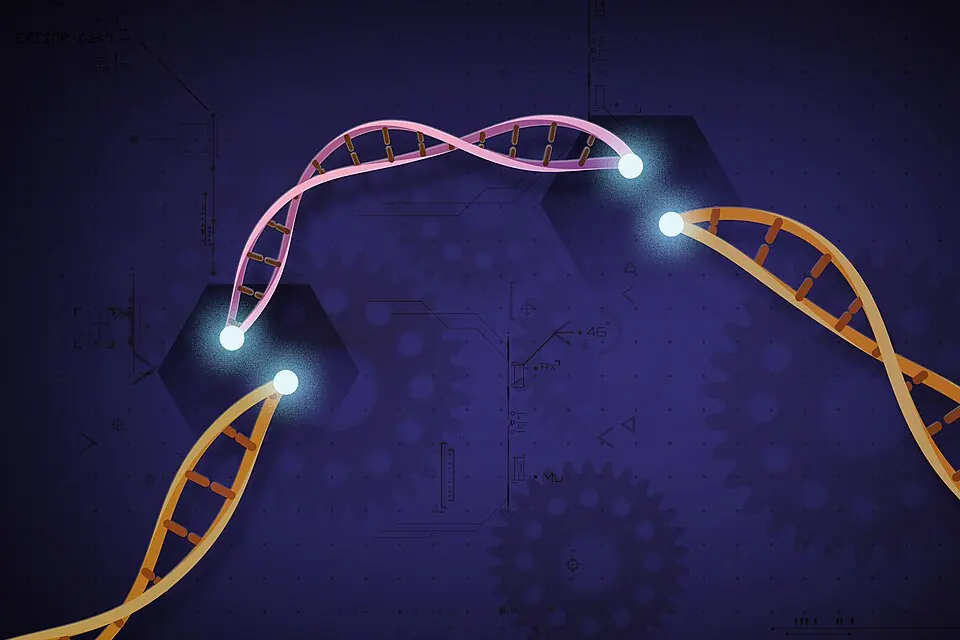
CRISPR, an acronym for clustered regularly interspaced short palindromic repeats, designates a bacterial defence mechanism: the bacterium keeps in its genome fragments of the viruses that have attacked it and produces RNA copies of them, which guide a protein, Cas9, to the corresponding viral DNA, which it cuts. In 2012 it was shown that this guide could be composed at will, and its two RNAs fused into a single programmable molecule: Cas9 then cuts DNA at the sequence supplied to it. The cut is only the first half of editing. A cell repairs cut DNA immediately, and in two ways: left to itself, it rejoins the ends by non-homologous end joining, losing or adding a few bases, which suffices to inactivate the gene; if a template of the desired sequence is supplied, it uses it by homologous recombination and copies the correction. The operation therefore consists in cutting at a determined location and directing the repair.
Why it matters
Genome editing, which previously required designing a specific protein for each target, has become a rapid and inexpensive operation accessible to any laboratory. The first authorised therapies, including a treatment for sickle cell disease, have reached patients. The technique restores at real scale the questions posed at Asilomar in 1975: edited crops, modification of wild populations and, after an experiment conducted on human embryos in 2018, editing transmissible to descendants.
Dating & uncertainty
Two teams publish in 2012 within a few weeks of each other: Jinek, Charpentier, Doudna and colleagues demonstrate RNA-guided Cas9 with a composable guide and construct the chimeric single guide; Gasiunas and Siksnys establish the same RNA-guided cut in Streptococcus thermophilus. The 2020 Nobel Prize in Chemistry is awarded to Charpentier and Doudna; the priority disputes, scientific and legal, form part of the record.
Our species’ history as one day
23:59:563.8 s before midnight
if the 315,000 years of Homo sapiens were compressed into a single day