TECHNOLOGY
Deep Learning and Neural Networks
~2012 CE
History · Contemporary · Holocene · Meghalayan
Deep learning, the training of many-layered neural networks on large masses of data, imposed itself in the early 2010s, notably at the ImageNet competition of 2012.
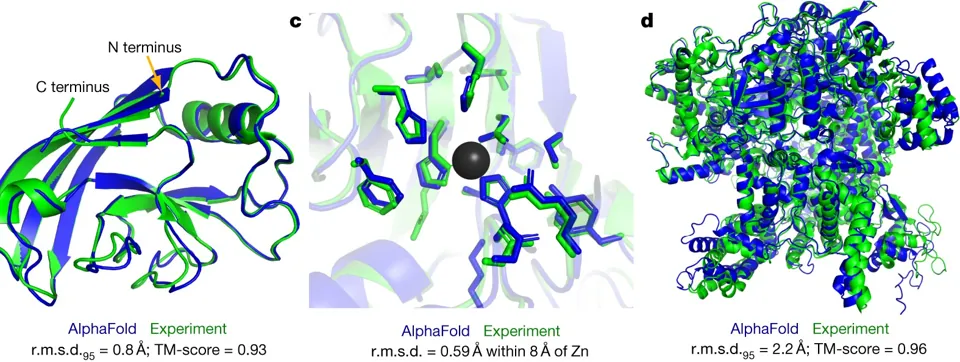
Deep learning designates the training of artificial neural networks with many layers on large masses of data. The principle is old, but results imposed themselves in the early 2010s, notably at the ImageNet image recognition competition in 2012. Training proceeds thus: the network starts from randomly drawn parameters and therefore produces arbitrary answers; an example is presented to it, its answer is compared with the expected one, then the network is traversed in reverse to modify each parameter slightly in the direction that would have reduced the discrepancy. The operation, called backpropagation, is repeated a very large number of times. The learned rule is written by no one: it resides in the values of those parameters. The same approach has been applied to scientific problems, the AlphaFold system predicting in 2021 the structures of proteins with atomic accuracy, fifty years after the problem was formulated.
Why it matters
The earlier techniques on this timeline extended muscular force, the sense organs or memory; this one bears on the faculty that produced all the others. Its consequences are not established: like fire, writing or nuclear energy at their appearance, learning systems constitute at this stage a capacity whose use remains to be determined.
Dating & uncertainty
The anchoring in the early 2010s corresponds to the moment deep learning imposed itself in vision and speech recognition, following the periodisation established by the discipline itself. Conversational systems for the general public follow a decade later.
Our species’ history as one day
23:59:563.8 s before midnight
if the 315,000 years of Homo sapiens were compressed into a single day