SOCIETY
The Global Fertility Decline
~1970 CE
History · Contemporary · Holocene · Meghalayan
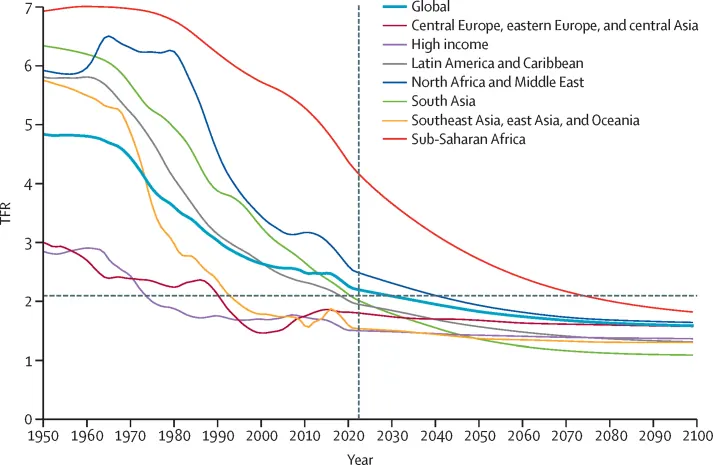
World fertility fell from 4.84 children per woman in 1950 to 2.23 in 2021, the last phase of the demographic transition, as girls went to school and contraception spread.
World fertility fell from 4.84 children per woman in 1950 to 2.23 in 2021, the final phase of the demographic transition, in which a regime of high mortality and high birth rates gives way to one in which both are low. The decline accompanies the schooling of girls, access to contraception, falling infant mortality and urbanisation. The inertia of the phenomenon follows from the age structure, an effect known as population momentum: a long-fertile population contains a high proportion of young people, who reach childbearing age for decades after fertility has fallen, so that numbers continue to grow even as each woman has fewer children. Once the population has aged, the same inertia works in reverse. Annual world births peaked in 2016.
Why it matters
After two centuries of rapid demographic growth, the question posed to societies becomes that of contraction and ageing, beginning with high-income countries. This transition proceeds from decentralised individual decisions and not from concerted policy. Projections place average world fertility near 1.6 children per woman in 2100, with more than half of births in sub-Saharan Africa.
Dating & uncertainty
The anchor around 1970 corresponds to the moment the decline became global. In 2021, fertility was below replacement level in more than half of countries. Debate no longer bears on whether world population will peak this century, but on when, and on the slope of the decline that follows.
Our species’ history as one day
23:59:4415.4 s before midnight
if the 315,000 years of Homo sapiens were compressed into a single day