PEOPLING
Lucy: Australopithecus afarensis
1974 CE
History · Contemporary · Holocene · Meghalayan
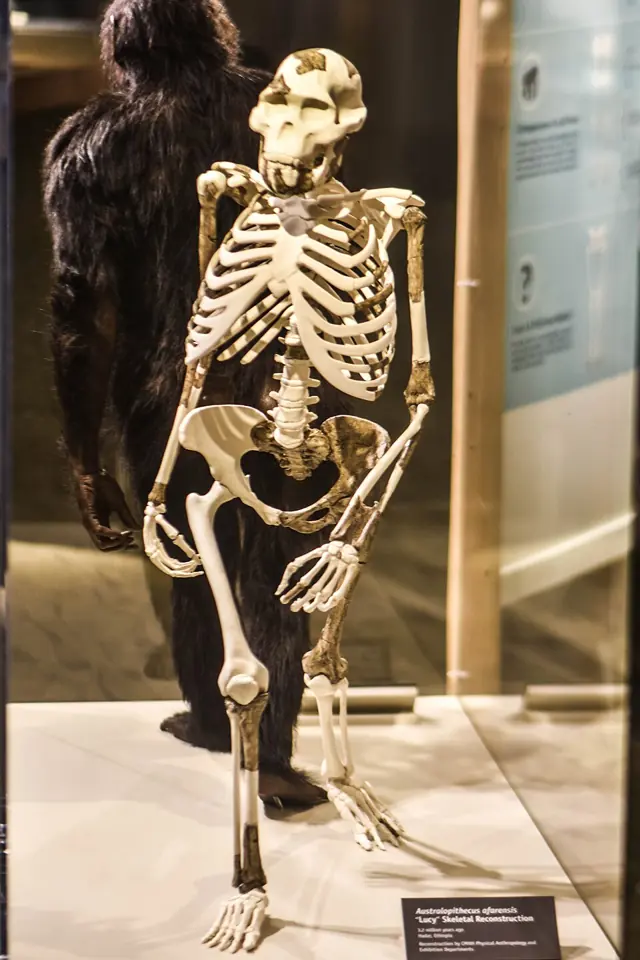
Lucy is a partial skeleton of Australopithecus afarensis, about 3.2 million years old, found in November 1974 at Hadar, in Ethiopia, with forty per cent of the bones recovered.
Lucy, catalogued AL 288-1 and called Dinkinesh in Amharic, is a partial skeleton of Australopithecus afarensis discovered in November 1974 at Hadar, in the Afar depression of Ethiopia, and dated to about 3.2 million years; about forty per cent of the skeleton was recovered. The proportion of parts from a single individual constitutes the principal interest of the find: measuring body proportions presupposes knowing that the arm and the leg belonged to the same person, whereas bones collected separately in a deposit may come from distinct individuals, or even species, and are therefore not comparable. The anatomy observed combines upper limbs of proportions close to our own, short lower limbs and a pelvic girdle adapted to bipedalism, a combination without equivalent among living species.
Why it matters
The specimen established that bipedalism preceded the increase in brain volume by several million years, the reverse of the order postulated by earlier models. It moreover gave palaeoanthropology a reference object identifiable by the public, and its locomotor efficiency was discussed for several decades.
Dating & uncertainty
Lucy lived about 3.2 million years ago, well before the chronological window of this edition, so that the entry is anchored on the date of discovery. Later finds, including an older and larger skeleton, confirmed that bipedalism was already fully constituted in this species.
Our species’ history as one day
23:59:4514.3 s before midnight
if the 315,000 years of Homo sapiens were compressed into a single day