LIFE × EVOLUTION
The Rhynie Chert
~407 million years ago
Phanerozoic · Paleozoic · Devonian
The Rhynie chert, in Aberdeenshire, is a wetland that the silica-rich water of a hot spring petrified cell by cell about 407 million years ago, with plants still standing where they grew.
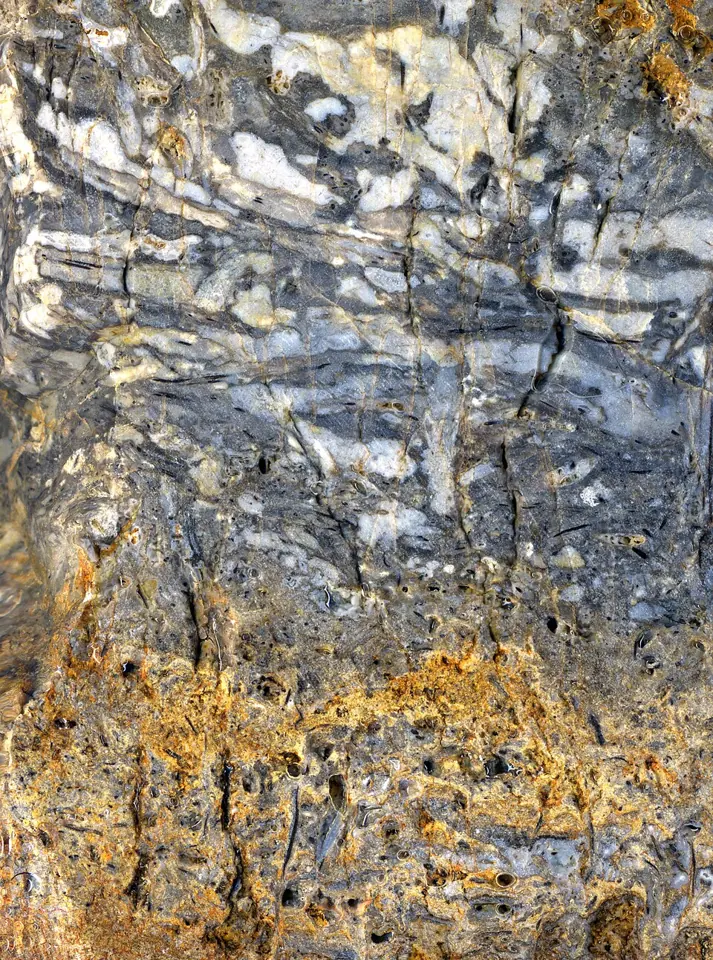
The Rhynie chert is a rock deposit in what is now Aberdeenshire. Chert is a rock composed of microcrystalline silica, the substance of quartz in microscopic crystals. The deposit formed when silica-rich water from a hot spring flooded a wetland and petrified it cell by cell. In places the rock contains plants still standing where they grew. It also contains the oldest known nematode worm, or roundworm. It contains the oldest mites, tiny relatives of spiders, and the oldest springtails, tiny wingless relatives of insects. The rock also contains a centipede and the earliest harvestman, a long-legged relative of spiders, with its breathing tubes and genitalia intact. The chewing mouthparts of the first true insect are preserved too. Coprolites, which are fossilised droppings, lie alongside these animals, and researchers use them to identify what the animals ate.
Why it matters
The Rhynie chert preserves an early terrestrial ecosystem more completely than any other deposit: everything else of this age is preserved as fragments. The chert preserves trophic relations, between an eater and what it eats, commensal relations, in which one species benefits from another without harming it, and associations already established. The coprolites alone lead researchers to question the old hypothesis that several of these animals fed on spores.
Dating & uncertainty
Researchers date the deposit to the Early Devonian, about 407 million years ago. The deposit shows the life of a hot spring. Its flora has low diversity and tolerates water that is hot, alkaline, meaning the opposite of acidic, and brackish, or slightly salty. The preserved community may therefore be atypical of the Devonian world rather than representative of it.
Earth history as one day
21:50:542 h 9 min before midnight
if Earth’s 4.54 billion years were compressed into a single day