CLIMATE
The 8.2 ka Cold Event
~8,200 years ago
Phanerozoic · Cenozoic · Quaternary · Holocene · Northgrippian
The largest climate swing of the last ten thousand years occurred about 8,200 years ago, when much of the northern hemisphere cooled by one to three degrees for some 160 years, a cooling recorded in Greenland ice.
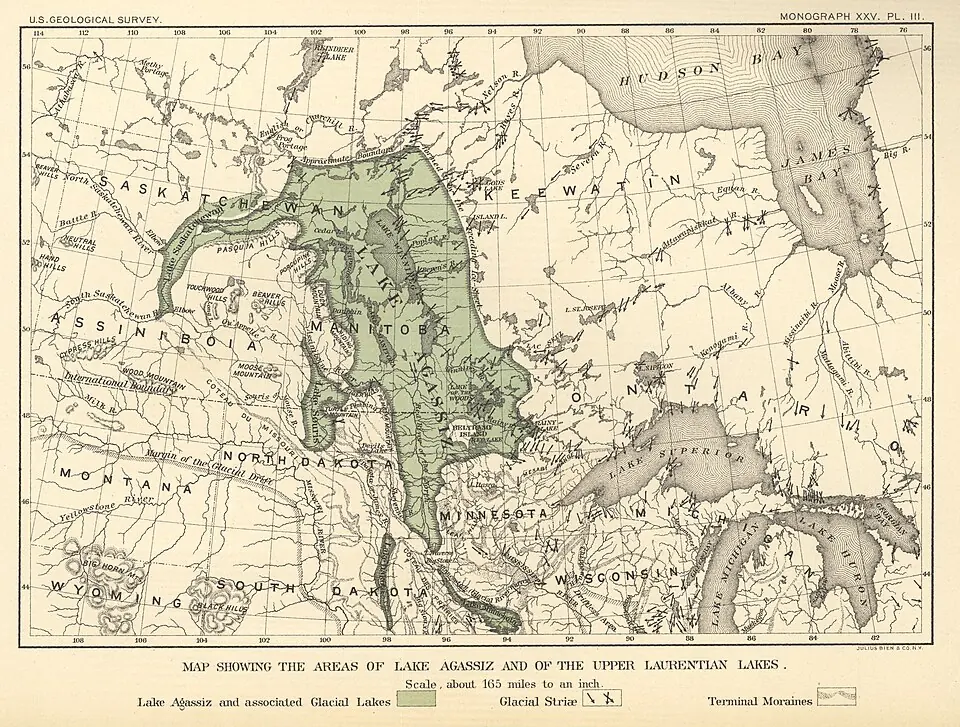
The 8.2 ka event, named for its age of 8.2 thousand years, is the largest climate swing of the last ten thousand years. For about a hundred and sixty years, much of the northern hemisphere was one to three degrees colder. The cooling is recorded in Greenland ice. On the Californian coast, a stalagmite, a mineral column that grows from a cave floor, recorded stormier and wetter winters at the same moment. The event occurred as Agassiz and Ojibway, the last great ice-dammed lakes of North America, held back by a barrier of ice, emptied into the sea. In the models of Matero and colleagues (2017), the duration of the cooling is better matched if the meltwater, the water from melting ice, came instead from the collapse of the ice saddle, the lower band of ice that linked the ice domes over Hudson Bay.
Why it matters
Agriculture, cities and writing were developed during the last ten thousand years, a period whose climate appears stable only by comparison with the ice ages. The 8.2 ka event brought a century and a half of harsher winters within that period, the interval taken to be the most stable.
Dating & uncertainty
The cooling lasted about 160 years and reached one to three degrees across much of the northern hemisphere. Researchers long held its trigger to be the abrupt emptying of two lakes dammed by ice. Modelling by Matero and colleagues (2017) indicates that the collapse of the ice saddle over Hudson Bay accounts better for that duration.
Earth history as one day
23:59:59.84156 ms before midnight
if Earth’s 4.54 billion years were compressed into a single day