EARTH × TECHNOLOGY
James Hutton and Deep Time
1788 CE
Phanerozoic · Cenozoic · Quaternary · Holocene · Meghalayan
James Hutton examined two sets of rock layers meeting at right angles at Siccar Point, on the Scottish coast, in 1788, and inferred from them a sequence of events too long for any short chronology, which is the idea of deep time.
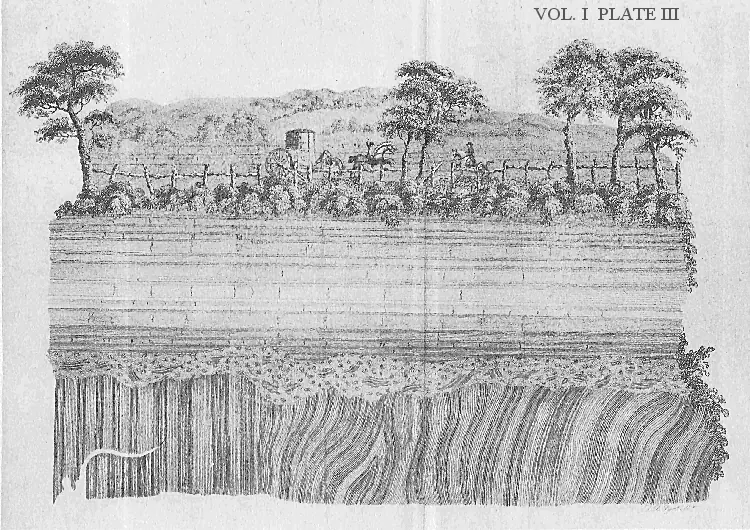
Deep time is the immense duration of the Earth's past, which James Hutton inferred from rocks at Siccar Point, on the Scottish coast. Hutton examined there two sets of rock layers meeting at right angles, a structure now called an angular unconformity. He deduced the sequence of events that this structure required: a seafloor was deposited, hardened, tilted on end, planed flat, submerged again and buried under new sediment. Each step takes a very long time, so the structure is itself proof of a very long duration. Nothing in the rock marks where the sequence begins, and this is the observation the phrase records.
Why it matters
This timeline depends on Hutton's inference of deep time. Before that inference, the Earth was thought to be a few thousand years old, and the strata, the layers of rock, were thought to be accidental. After the inference, the strata constitute a record, of a duration sufficient to contain everything this timeline presents. Deep time had to be inferred before anything on the timeline could be dated.
Dating & uncertainty
Hutton's theory was read to the Royal Society of Edinburgh in 1785 and published in 1788. The angular unconformity at Siccar Point is the outcrop, the place where the rock is exposed, that made his argument for deep time observable. There, vertical strata are truncated, that is, cut off, beneath horizontal ones.
Earth history as one day
23:59:59.99554.5 ms before midnight
if Earth’s 4.54 billion years were compressed into a single day