TECHNOLOGY × HUMAN EVOLUTION
The First Vaccine
1796 CE
Phanerozoic · Cenozoic · Quaternary · Holocene · Meghalayan
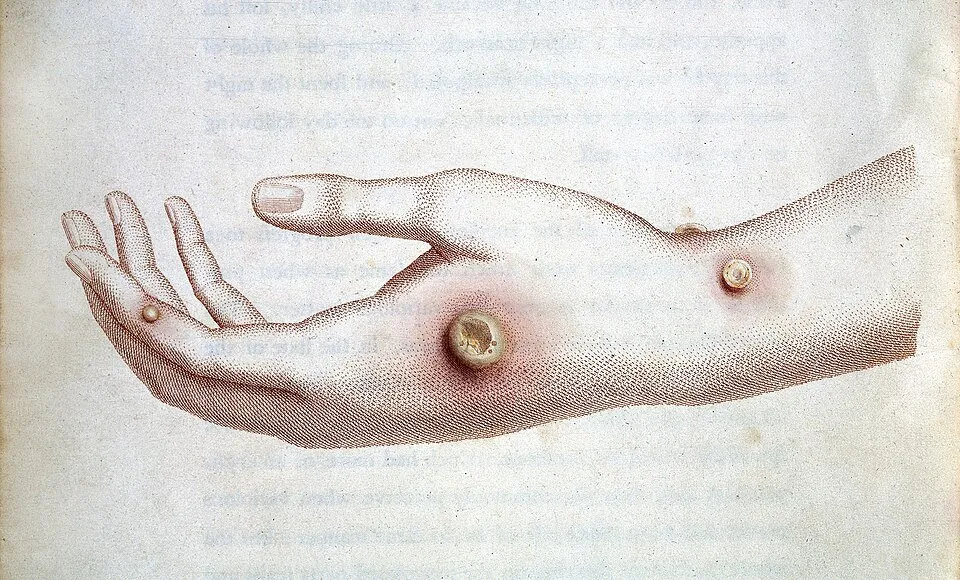
Vaccination began in 1796 with the deliberate transmission of cowpox, a mild disease of cattle, to people in order to protect them against smallpox, a century before viruses were known.
Vaccination began as the deliberate transmission of cowpox to a person, to protect that person against smallpox. Cowpox is caught from cattle, and smallpox is a lethal disease caught from people. The practice takes its name from vacca, the Latin word for cow. It worked a century before viruses were known, and the reason took longer still to establish. The body makes antibodies, proteins that attach to an infecting virus. The cowpox and smallpox viruses are similar enough that antibodies made against one recognise the other, a phenomenon called cross-reaction.
Why it matters
Inoculation, the deliberate infection of a healthy person, had long been practised with smallpox itself, and it killed a proportion of those who received it. Cowpox is a milder related disease, and it protected without killing. The protection could therefore be repeated and given to a whole population. Protection on that scale turned a treatment into a campaign, and the campaign succeeded: smallpox is the only human disease that humans have deliberately eradicated.
Dating & uncertainty
Inoculation with smallpox itself was practised in Asia and Africa well before 1796. The date of 1796 marks the use of cowpox in place of smallpox.
Earth history as one day
23:59:59.99564.4 ms before midnight
if Earth’s 4.54 billion years were compressed into a single day