LIFE × EVOLUTION
The Origin of Insect Flight
~325 million years ago (molecular estimates up to 406 Ma)
Phanerozoic · Paleozoic · Carboniferous
Insects were the first animals to fly under their own power, about 325 million years ago, perhaps ninety million years before any vertebrate, and researchers argued for a century over the origin of their wings.
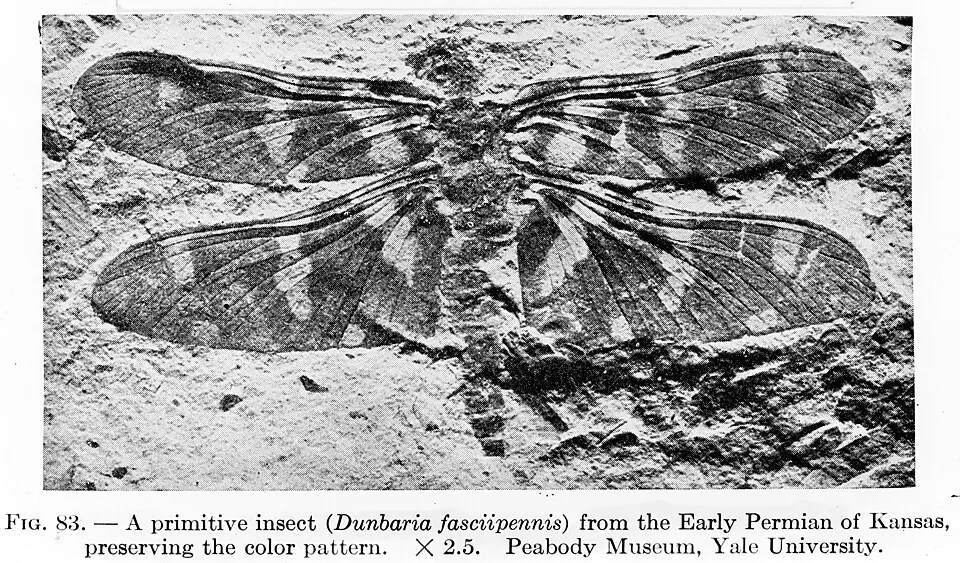
Insect flight is the oldest powered flight, meaning flight driven by the animal's own muscles. Insects achieved it perhaps ninety million years before any vertebrate. For a century, researchers argued between two origins for the wing. In one, the wing derives from the side of the body, where a leg attaches. In the other, it derives from the back, as an outgrowth of the cuticle, the hard outer covering of an insect. Prokop and colleagues (2017) studied Carboniferous nymphs, the immature stages of insects. The wing pads of these nymphs, the buds of the future wings, are hinged to the side like a leg and joined broadly to the back like a fold of the cuticle. The wing therefore derives from both the side and the back, and the question is largely settled. By 312 million years ago the flying lineages were already varied. One insect from these lineages left a full-body impression in the mud where it landed.
Why it matters
Flight gave insects a means of escape and access to food resources they could not otherwise reach. For some ninety million years, no other animal flew. Insects remain the most diverse animals on the planet, and their wings are a substantial part of the reason.
Dating & uncertaintyDisputed
The oldest fossils and traces of winged insects are Carboniferous, from about 325 to 312 million years ago. Misof and colleagues (2014) place the origin of wings around 406 million years ago with phylogenomic estimates, molecular clocks that date a lineage from differences between the genomes of living species. Schachat and colleagues (2022) find no support in the fossil record for the preservation and sampling biases, fossils destroyed or never collected, that so long a gap would require. They interpret the early date as an artefact of taxon sampling, the choice of species analysed, and of the fossils used to calibrate the clock, that is, to set its rate.
Earth history as one day
22:16:541 h 43 min before midnight
if Earth’s 4.54 billion years were compressed into a single day