EARTH
Pangaea
~335 to 175 million years ago
Phanerozoic · Paleozoic · Carboniferous
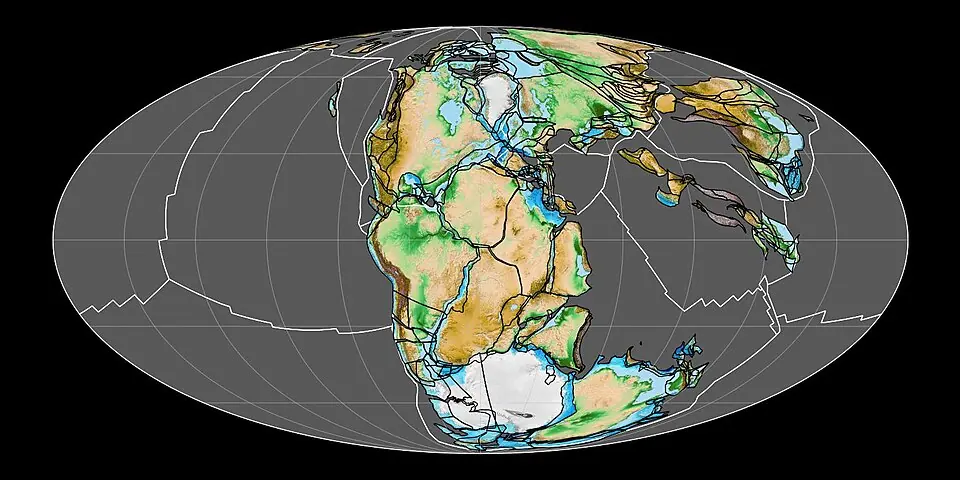
Pangaea was a supercontinent that united nearly all the land in a single mass from pole to pole, surrounded by a single ocean, Panthalassa, with an interior a thousand kilometres from any coast, from 335 to 175 million years ago.
Pangaea is the supercontinent formed by the union of nearly all continental masses into a single body extending from pole to pole. A single ocean, Panthalassa, surrounded it. The interior of Pangaea lay a thousand kilometres from any coast. Oceanic moisture did not reach that far, and the centre of the continent was desert. A continental mass heats and cools far more sharply than an ocean does. On Pangaea this difference produced a monsoon regime, in which winds and rains reverse with the seasons, of an amplitude without modern equivalent, termed the megamonsoon.
Why it matters
On a single continent, species that had long been separated met and mixed. The length of coastlines diminished. The sea moderated the climate less, and the climate varied more strongly from season to season and from millennium to millennium. Pangaea subsequently fractured, and its fragments are the present-day continents.
Dating & uncertainty
The collisions between continents that formed Pangaea began about 380 million years ago. The last pieces joined in the Late Carboniferous or in the Permian, the period that follows it, depending on which suture, the scar left where two continents collided, is taken as final. Break-up began around 200 million years ago, and the central Atlantic opened around 175 million years ago.
Earth history as one day
22:13:441 h 46 min before midnight
if Earth’s 4.54 billion years were compressed into a single day