ATMOSPHERE × LIFE
The Age of Giant Insects
~330 to 260 million years ago
Phanerozoic · Paleozoic · Carboniferous
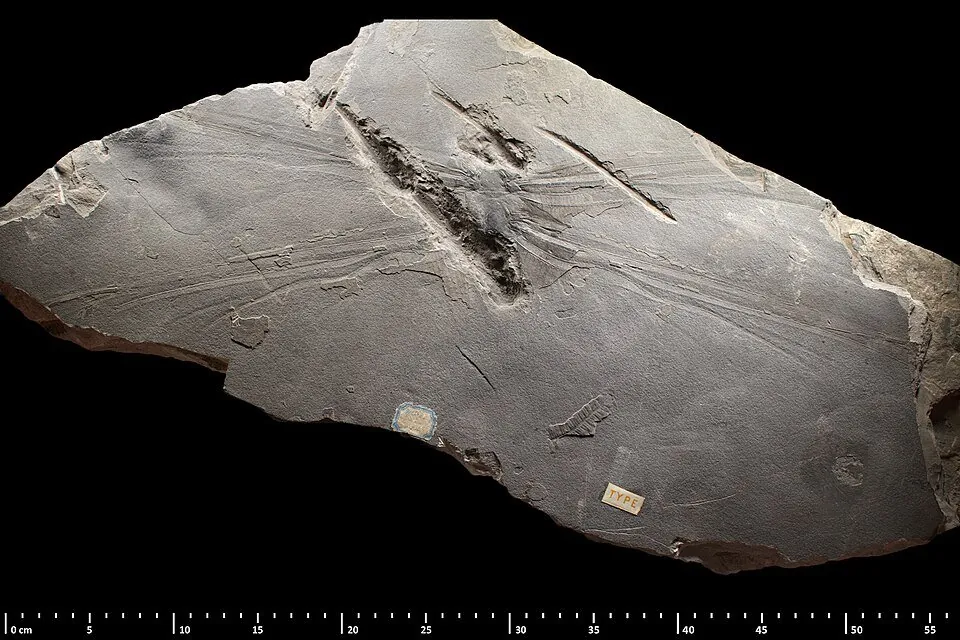
Relatives of dragonflies with wingspans reaching seventy centimetres flew between 330 and 260 million years ago, when coal swamps buried carbon faster than decay released it and oxygen rose to nearly a third of the atmosphere.
The age of giant insects is the interval in which atmospheric oxygen reached the highest level in the history of the Earth, near a third of the atmosphere instead of the present fifth. Coal swamps, forested swamps whose plant remains became coal, buried carbon faster than decay returned it, and the oxygen left over accumulated. Relatives of dragonflies with wingspans reaching seventy centimetres flew through these swamps. The usual explanation for their size is respiratory. Insects breathe through tracheae, tubes that carry air directly to the tissues. The air travels by diffusion, the spontaneous spread of a gas from where it is concentrated to where it is less so. The oxygen concentration outside limits how far this system reaches, so that air richer in oxygen permits a larger body. With so much oxygen, wildfires may also have been more frequent and at times catastrophic.
Why it matters
Life determined the composition of the atmosphere, and the atmosphere may in turn have limited the size of insects. Clapham and Karr (2012) measured more than ten thousand fossil wings. The size of the largest insects follows oxygen concentration for a hundred and fifty million years, then ceases to follow it. From the Early Cretaceous, a later geological period, the largest wings diminish while oxygen rises, at the same time as the expansion of the first birds. On the reading of these authors, predation then bounds the size of an insect, and the atmosphere no longer does.
Dating & uncertainty
Berner and colleagues (2003) report models built on the carbon and sulfur records, the traces of these two elements in rocks. These models place atmospheric oxygen between 30 and 35 per cent in the Late Carboniferous, markedly above the present 21 per cent. The link with large insects is plausible but not established. Clapham and Karr (2012) analysed wing lengths and found that maximum size follows oxygen only until the Cretaceous. After that, the radiation of birds, their diversification into many forms, accounts for maximum size better.
Earth history as one day
22:15:191 h 45 min before midnight
if Earth’s 4.54 billion years were compressed into a single day