EVOLUTION × LIFE
Synapsids: the Mammal Line
~315 to 300 million years ago
Phanerozoic · Paleozoic · Carboniferous
Synapsids, the lineage leading to mammals, split from sauropsids, the lineage leading to reptiles and birds, between 315 and 300 million years ago, when the amniotes, vertebrates independent of water, divided in two.
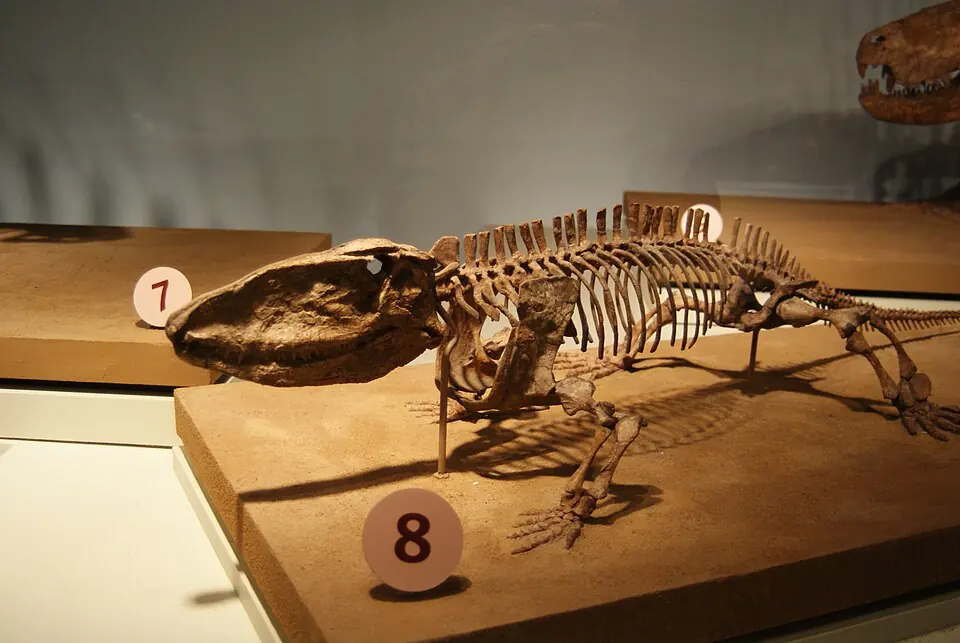
Synapsids are the lineage of amniotes that leads to mammals. Once vertebrates were independent of water, the amniote group divided into two lineages: sauropsids and synapsids. Palaeontologists tell the two lineages apart by an opening in the skull, the temporal fenestra, which lies behind the eye. Synapsids have a single temporal fenestra, sauropsids two or none. The arrangement of these openings determines how the jaw muscles attach. Early members of both lineages looked alike, low-slung and lizard-shaped, though some synapsids had a sail of elongated spines along the back.
Why it matters
Brocklehurst and colleagues (2022) followed the two lineages across the whole Carboniferous and the Early Permian, the start of the following period. Synapsids changed mainly in the body behind the head and reached large size early. Sauropsids changed that body far less and changed instead in the temporal region, the side of the skull behind the eye, and with it in the mechanics of the skull and jaw. Both lineages underwent an initial phase of rapid change that subsequently slowed, and sauropsids remained within a narrower range of forms. A large part of what separates a mammal from a lizard derives from that first divergence.
Dating & uncertainty
The amniote root, the base of the amniote family tree, is placed around 320 million years ago. The separation between the mammal and reptile stem lineages, the early branches leading to each group, follows closely. Both datings, however, rest on a sparse Carboniferous fossil record and shift with each phylogenetic reanalysis, that is, each new reconstruction of that tree.
Earth history as one day
22:20:051 h 40 min before midnight
if Earth’s 4.54 billion years were compressed into a single day