LIFE × EVOLUTION
Pterosaurs: the First Fliers
~220 million years ago
Phanerozoic · Mesozoic · Triassic
Pterosaurs were the first vertebrates to fly under their own power, about 220 million years ago, on a membrane stretched from a greatly elongated fourth finger to the ankle.
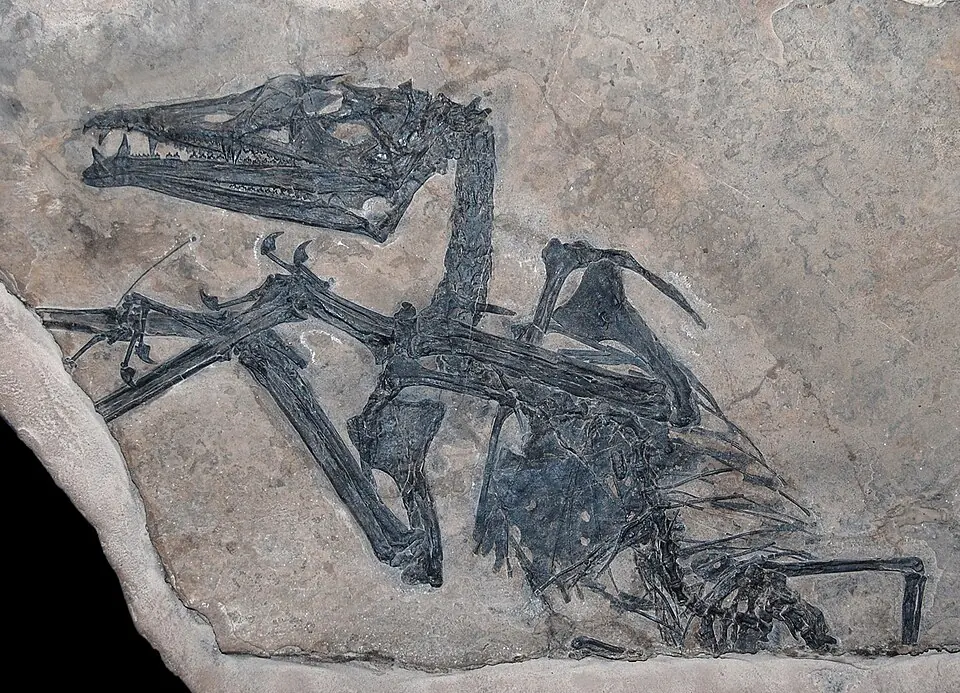
Pterosaurs were flying reptiles. They were the first vertebrates, the animals with a backbone, to achieve powered flight, which is flight under the animal's own power. They flew on a membrane that stretched from a greatly elongated fourth finger back to the ankle. Insects had been flying for a hundred million years, and no vertebrate had flown. The oldest pterosaurs are already complete fliers, so the fossils do not show the transitional stages. Ezcurra and colleagues (2020) identified their nearest known relatives, the lagerpetids. Lagerpetids were small running reptiles that never flew, and they already possessed the enlarged balance organs that flight requires.
Why it matters
Powered flight has appeared four times in animals, and the flight of pterosaurs is the second, after that of insects. The lagerpetids show that the organs flight requires existed before flight: their brain and their inner ear already had the configuration found in pterosaurs, in animals that did not leave the ground.
Dating & uncertainty
The date displayed is the rounded age of the oldest fossils that are pterosaurs without doubt. They come from the Upper Triassic, the rock layers of the last part of the Triassic period, and they are already fully flying animals. No fossil shows the transition that produced pterosaurs, so the group originated before that date, by an amount the fossils do not give. Ezcurra and colleagues recognised the lagerpetids as the closest known relatives of pterosaurs only in 2020. The lagerpetids reduced the gap in the fossils before the oldest pterosaurs, but did not close it.
Earth history as one day
22:50:131 h 10 min before midnight
if Earth’s 4.54 billion years were compressed into a single day