SUBSISTENCE × HEALTH
The Potato in Europe
~1700 CE
History · Early Modern · Holocene · Meghalayan
The potato, brought from the Andes, spread slowly through the Old World and became a major crop there around 1700, yielding more calories per field than cereals where the soil suits it.
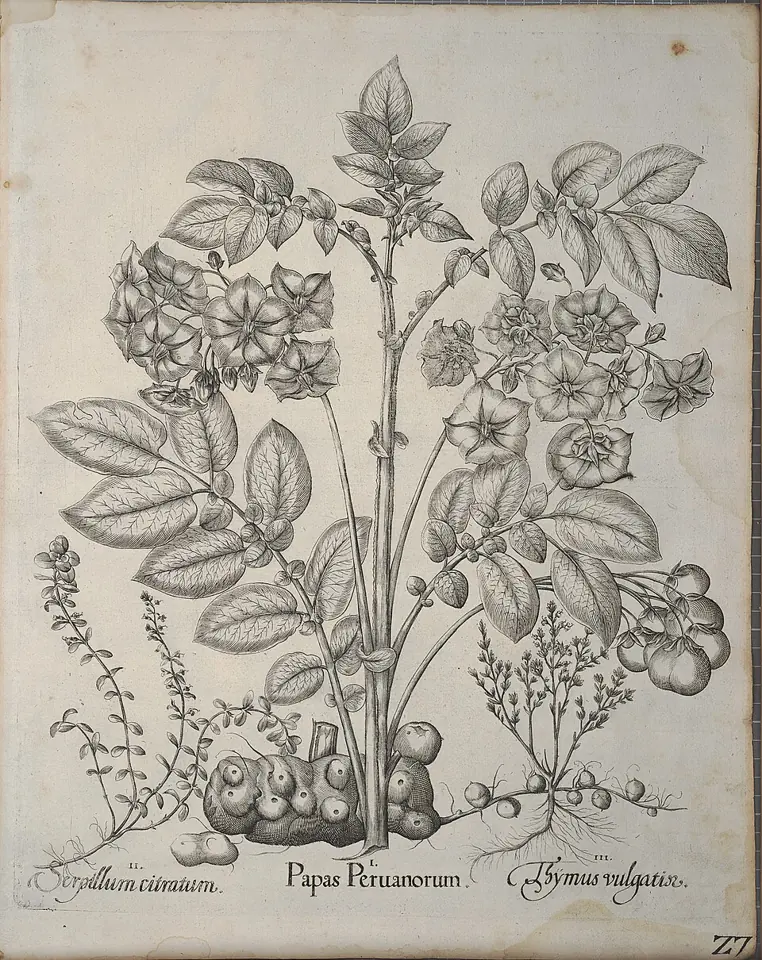
The potato, Solanum tuberosum, native to the Andes, spread slowly through the Old World before becoming a major crop there. Its caloric yield per unit area exceeds that of cereals where soil and climate suit it, for a physiological reason: the plant stores its starch in an underground tuber and therefore need produce neither supporting stalk, nor ear, nor grain casing, and it crops on cold, wet, poor soils unsuited to wheat. The corresponding demographic effect is estimated, on conservative assessments, at about a quarter of the growth in population and urbanisation of the Old World between 1700 and 1900. The gain is higher where milk consumption is widespread, milk supplying the lipids, calcium and vitamins the tuber does not, and lower where malaria was endemic.
Why it matters
The case supplies a measure of the demographic effect of the Columbian exchange, a species transferred between hemispheres having modified the population trajectory of Europe and Asia. It also documents the risk associated with specialisation: the dependence of a population on a single, genetically homogeneous crop translated in Ireland into a major famine on the appearance of blight.
Dating & uncertainty
The diffusion of the species in Europe begins in the sixteenth century, its adoption being slow; the date retained corresponds to the point from which the demographic effect is measured. The value of a quarter is an estimate obtained by comparison between suitable and unsuitable regions, before and after adoption; the same method establishes the attenuation of the gain in areas of endemic malaria.
Our species’ history as one day
23:58:301 min 29 s before midnight
if the 315,000 years of Homo sapiens were compressed into a single day