PEOPLING
Misliya: an Early Exit from Africa
~185,000 years ago (disputed)
Palaeolithic · Middle Stone Age · Saalian glacial
A jaw from Mount Carmel, in Israel, about 185,000 years old, is the earliest widely accepted trace of Homo sapiens outside Africa.
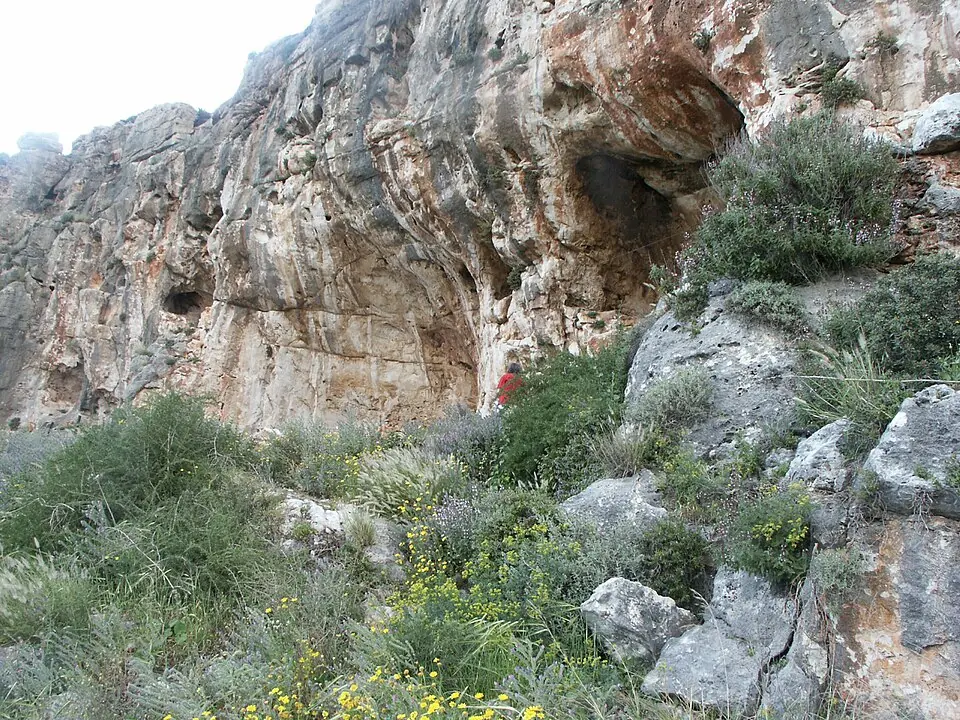
Misliya Cave is a collapsed shelter on the western slope of Mount Carmel, in Israel. It yielded half an upper jaw with its dentition, designated Misliya-1 and published in 2018, which constitutes the earliest widely accepted trace of Homo sapiens outside Africa, with an age of about 185,000 years established by three dating methods, nearly twice that of the neighbouring Skhul and Qafzeh fossils. The fossil was associated with tools belonging to the full Levallois method, a procedure in which a core is extensively prepared so that a single removal detaches a flake of predetermined shape. The appearance of the species in the Levant is thus associated with that of a new conception of knapping.
Why it matters
The site documents the fact that human groups were reaching western Asia long before the demographically decisive dispersal, without leaving descendants among present-day populations, genetics finding no trace of them in the living. The departure from Africa accordingly appears as a succession of expansions and retreats rather than as a single event.
Dating & uncertaintyDisputed
The fossil is not contested; its age is. Three independent methods date the maxilla to between 194,000 and 177,000 years. Part of the demonstration rests on the mineral crust formed on the bone, which can be dated where the bone itself cannot, and whose formation postdates the deposition of the fossil. A published comment objects that these data support only a minimum age of 70,000 to 60,000 years; the authors reply that removing them changes little, the other methods sufficing on their own. The older dating is retained here, together with a note of the dispute.
Our species’ history as one day
09:54:1714 h 6 min before midnight
if the 315,000 years of Homo sapiens were compressed into a single day