SOCIETY × SUBSISTENCE
Border Cave: the Oldest Bedding
~200,000 years ago
Palaeolithic · Middle Stone Age · MIS 7
At Border Cave, in southern Africa, people were spreading grass bedding over ash at least 200,000 years ago.
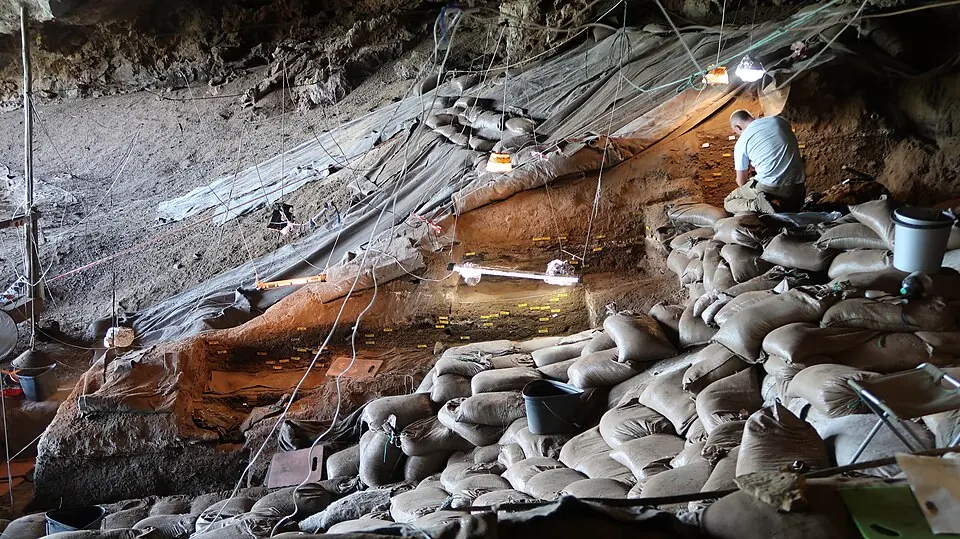
Border Cave is a rock shelter in the Lebombo Mountains, on the border between South Africa and Eswatini, whose deposits document a long sequence of human occupation. The oldest levels, dated to at least 200,000 years, have yielded layers of broad-leafed grasses spread over beds of ash and interpreted as bedding for rest and for work. The underlying ash frequently corresponds to earlier bedding burned in place, a practice the excavators relate to the maintenance of the inhabited space and, on a hypothesis they advance, to limiting crawling insects. The usage persists for more than 150,000 years, the sequence recording bedding successively laid, used, burned and remade.
Why it matters
Arrangements of this kind survive only exceptionally, so that the history of the material conditions of rest remains very poorly documented for the Palaeolithic. The site provides one of its rare early attestations, with floors maintained by fire and a space assigned to sleep. At Sibudu, 77,000 years ago, bedding of sedge was covered with aromatic leaves whose compounds are toxic to insect larvae, documenting the application of botanical knowledge to the dwelling.
Dating & uncertainty
The date is a minimum age: the oldest bedding comes from levels at least 200,000 years old, and the practice continues in the cave more than 150,000 years later. Identification required microscopic examination. Grasses take up dissolved silica from the soil and deposit it inside their cells; when the plant decays, that silica retains the shape of the cell it occupied. These microscopic casts are what survives, together with traces of compaction and, in places, of burning.
Our species’ history as one day
08:45:4215 h 14 min before midnight
if the 315,000 years of Homo sapiens were compressed into a single day