GENETICS
Neanderthal Admixture in Our DNA
~50,500 to 43,500 years ago
Palaeolithic · Upper Palaeolithic · Last glacial
Between about 50,500 and 43,500 years ago, Homo sapiens and Neanderthals interbred, leaving two to three per cent of Neanderthal DNA in all non-Africans.
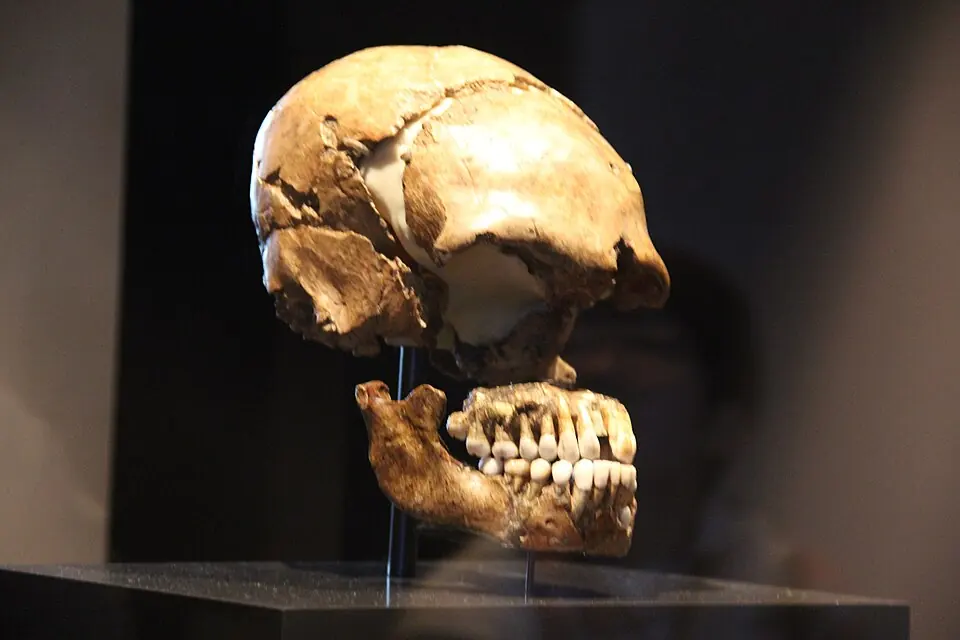
Admixture between Homo sapiens and Neanderthals designates the genetic exchanges from which derive the two to three per cent of Neanderthal DNA carried by every population of non-African origin. Its dating rests on recombination: at each generation the two chromosomes of a pair exchange segments, so that an inherited block is shortened at every transmission, and the length of the Neanderthal blocks measures the number of generations since their introduction. Applied to ancient genomes, the method places the bulk of the gene flow in a single extended period, between about 50,500 and 43,500 years ago, most probably in south-west Asia, shared by the ancestors of all non-African populations. Natural selection subsequently eliminated some of the introduced variants and favoured others.
Why it matters
The episode is documented by genetics rather than by stratigraphy, and its date, shared by all the populations concerned, provides a reference point for the dispersal as a whole: remains of Homo sapiens found outside Africa and predating 50,000 years probably belong to populations other than the one from which sequenced non-African genomes descend. The inherited variants concern immunity, skin characters and metabolism in particular, and remain functional in present-day populations.
Dating & uncertainty
Ancient genomes narrow the bulk of the gene flow to a single period between about 50,500 and 43,500 years ago; the oldest European genomes carry segments from the same episode, dated in them to 49,000 to 45,000 years. The duration of contact within that window remains undetermined, for a methodological reason: segment lengths constrain the date of admixture far better than its duration.
Our species’ history as one day
20:25:083 h 35 min before midnight
if the 315,000 years of Homo sapiens were compressed into a single day