GENETICS
Mitochondrial Eve
~200,000 years ago
Palaeolithic · Middle Stone Age · MIS 7
All living humans inherit their mitochondrial DNA from one woman who lived in Africa about 200,000 years ago, one ancestor among many.
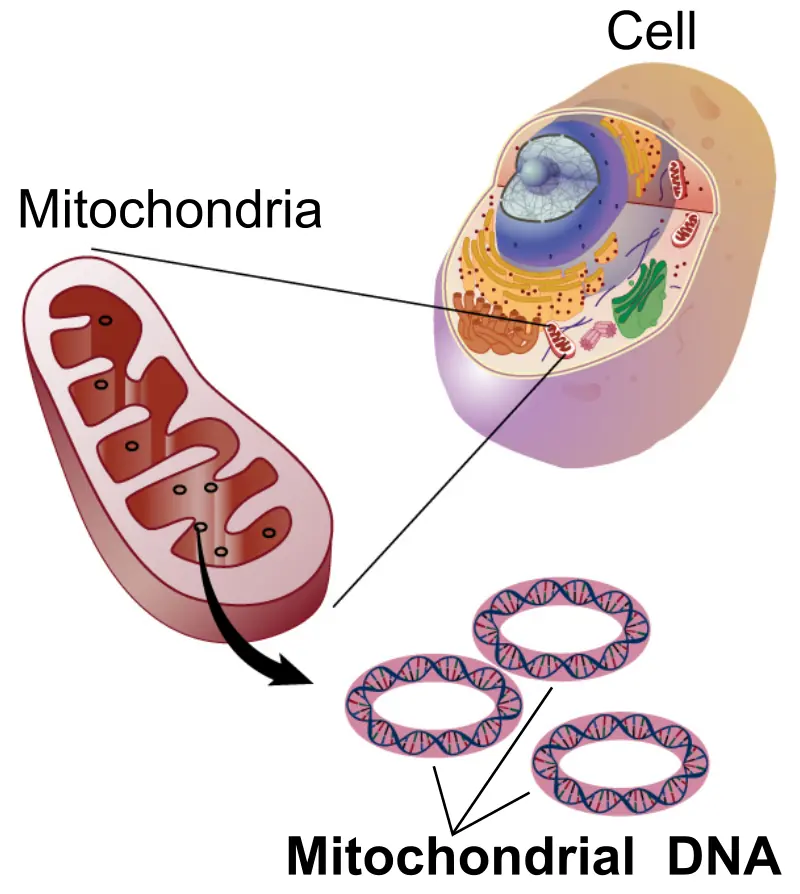
Mitochondrial Eve is the name given, in popular literature, to the most recent matrilineal common ancestor of present-day humanity, that is, the woman from whom all living humans descend through an unbroken chain of maternal descent. The concept rests on a property of mitochondrial DNA: mitochondria, the energy-producing structures of the cell, carry DNA of their own that a child receives from its mother alone, so that its genealogy contains no paternal branch. A study published in 1987 reconstructed from this DNA, sampled from 147 people in five regions of the world, a single tree whose root lay about 200,000 years ago, in all likelihood in Africa. A later study of 189 people, including 121 Africans, confirmed the structure of the tree, marked by numerous deep branches leading exclusively to African populations, and placed that ancestor between 166,000 and 249,000 years ago.
Why it matters
The concept gives rise to a frequent misunderstanding, which follows from the method used: the tree has a single line because mitochondrial DNA transmits only one. The ancestor in question was neither the first woman nor the only one of her time, and her contemporaries also have living descendants, though not through an unbroken succession of daughters. Every other portion of the genome has its own tree and its own common ancestor, in most cases considerably older. What the mitochondrial root establishes is that the deepest branches of human genealogy lie in Africa, non-African populations forming only a recent shoot.
Dating & uncertainty
The estimate is statistical rather than palaeontological. The method counts differences between mitochondrial genomes and converts them into elapsed time, which requires the rate at which those differences accumulate to be known. That rate is the weak point of the calculation: the values proposed yield ages between roughly 100,000 and 250,000 years, the 1991 study, calibrated against chimpanzees, giving 166,000 to 249,000 years. The name is retained here because of its widespread use, and not because humanity descends from a single woman, which population genetics contradicts.
Our species’ history as one day
08:45:4215 h 14 min before midnight
if the 315,000 years of Homo sapiens were compressed into a single day