PEOPLING
Homo floresiensis: the Hobbit
~100,000 to 50,000 years ago
Palaeolithic · Upper Palaeolithic · Last glacial
Homo floresiensis, a human species barely a metre tall, lived on the island of Flores until about 50,000 years ago.
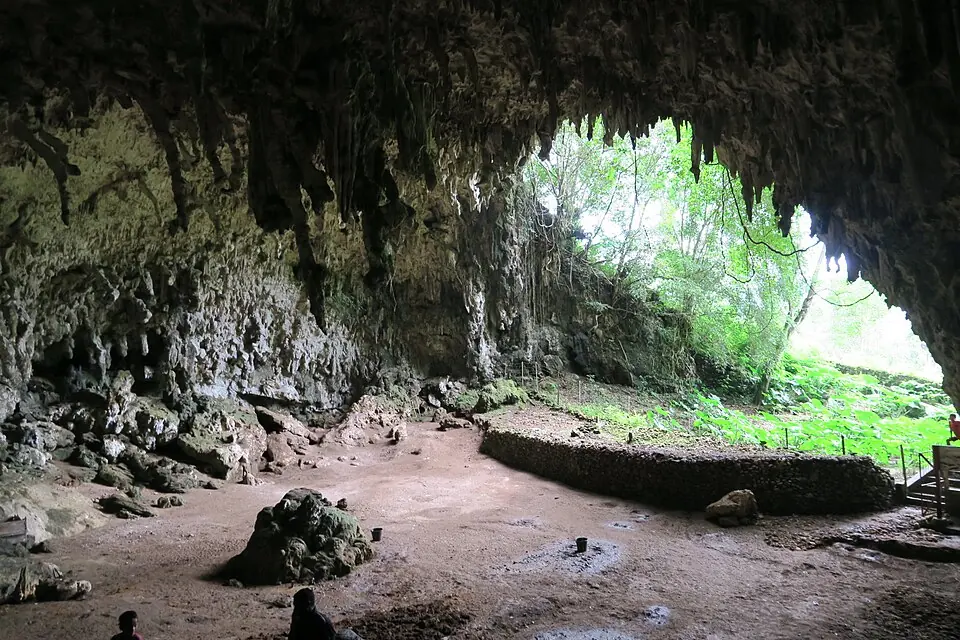
Homo floresiensis is a hominin species described in 2004 from remains recovered in Liang Bua cave, in western Flores, Indonesia. The individuals stood a little over a metre tall and had a cranial capacity comparable to that of a chimpanzee; the associated levels yielded a lithic industry and remains of dwarf Stegodon, small-bodied island proboscideans. The species disappears from the deposits around 50,000 years ago, at the same time as the island's endemic giant stork and vulture, a period corresponding to the arrival of Homo sapiens in the region; a change of lithic raw material in the cave, around 46,000 years ago, is related by some authors to those newcomers.
Why it matters
The case documents the diversity of human forms contemporary with the dispersal of Homo sapiens, at least four distinct lineages then surviving, among them a small-bodied island population whose ancestors had crossed a sea strait. The coincidence between its disappearance and the arrival of modern populations raises, at the scale of one island, the question also posed for Neanderthals and Denisovans; no data to date establish a causal relation.
Dating & uncertainty
The chronology of the site has been revised. The skeletons were first dated between 95,000 and 12,000 years, which implied a long coexistence with Homo sapiens. Renewed excavation identified the source of the error: the recent ages came from sediments deposited above the remains after a phase of erosion had cut into the older deposits, and therefore dated that fill and not the fossil-bearing layer. The remains now fall between about 100,000 and 60,000 years, and the tools attributed to the species do not postdate 50,000 years.
Our species’ history as one day
20:11:253 h 49 min before midnight
if the 315,000 years of Homo sapiens were compressed into a single day