BELIEFS
Qafzeh and Skhul: the Oldest Burials
~92,000 years ago
Palaeolithic · Middle Stone Age · Last glacial
In two caves of the Levant, Homo sapiens buried their dead in dug pits, with objects and pigment, from about 92,000 years ago.
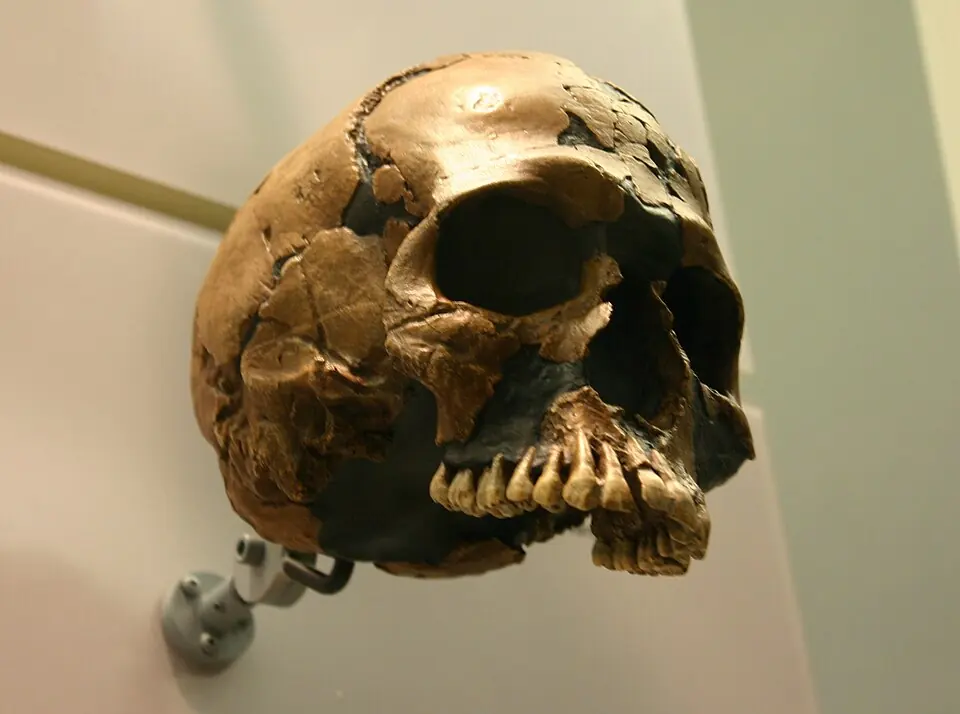
The caves of Qafzeh, near Nazareth, and Skhul, on Mount Carmel, have yielded the oldest known burials attributed to Homo sapiens, the most recent of which date to about 92,000 years ago. The bodies were placed in dug pits, sometimes in pairs, an adult with a child. Three criteria together distinguish a burial from a body fallen into a natural hollow: the pit was dug rather than natural, the body was arranged rather than collapsed, and objects were placed with it. The lower levels of Qafzeh also produced hearths, blocks of red ochre and whole shells from a shore thirty-five kilometres away, several bearing traces of suspension and a few ochre staining; most come from levels slightly earlier than the burials.
Why it matters
These interments document a treatment of the dead involving labour without utilitarian return, and the association of objects and pigment with the funerary deposit. They constitute the oldest known burials with a symbolic component, of any human species. Their makers used the Mousterian toolkit also employed by Neanderthals, so that the practice does not correlate with a technical difference.
Dating & uncertainty
Burnt flints from the burial layers at Qafzeh are dated to 100,000 to 90,000 years by thermoluminescence; the Skhul burials fall between 135,000 and 100,000 years, on the assumption of deposition over a short span. No burial can individually be designated the oldest; it is the group that constitutes the oldest known.
Our species’ history as one day
16:59:257 h 1 min before midnight
if the 315,000 years of Homo sapiens were compressed into a single day