PEOPLING × BELIEFS
Herto: Homo sapiens idaltu
~160,000 to 154,000 years ago
Palaeolithic · Middle Stone Age · Saalian glacial
Three skulls from Ethiopia, about 160,000 years old, stand between older African fossils and modern humans.
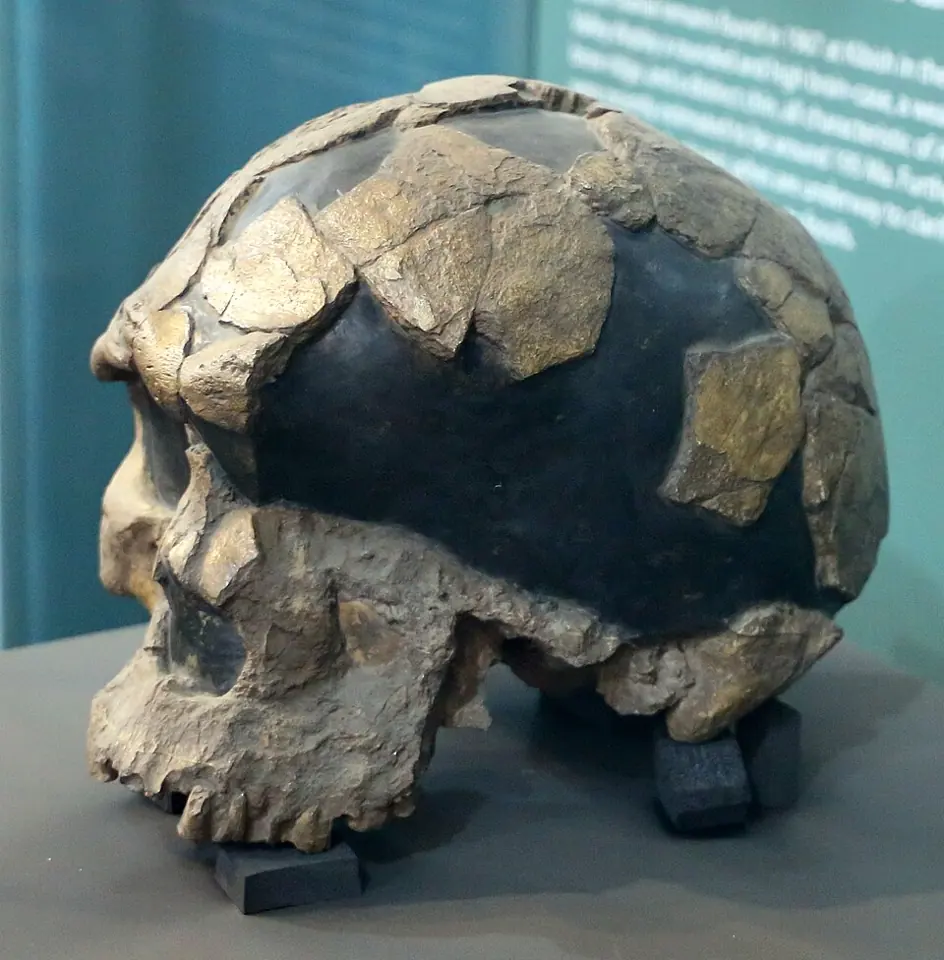
The Herto crania are three human fossils recovered in 1997 at the site of Herto Bouri, in the Middle Awash valley of the Afar region, Ethiopia, and described in 2003. They comprise two adults and a child whose morphology stands between that of older African fossils and that of later modern humans; their discoverers assigned them to a subspecies proposed for the purpose, Homo sapiens idaltu, idaltu meaning elder in the Afar language, the validity of which is not universally accepted. All three crania bear fine cut marks and polish produced after death. The polish is the principal indication: a bone surface acquires a sheen only through repeated rubbing, which implies prolonged handling rather than abandonment, and the child's cranium shows the most pronounced traces. The same levels have yielded hippopotamus carcasses butchered beside a now-vanished lake, associated with tools belonging to both the Acheulean and the Middle Stone Age.
Why it matters
The treatment these crania received is interpreted as a mortuary practice, though not a burial: defleshing a skull and keeping it is not interring it, and the meaning of the act remains unknown. That it was deliberate and repeated is nevertheless established by the convergence of the two traces, the cut marks attesting the defleshing and the polish the subsequent handling. Such behaviour precedes the oldest known graves by several tens of millennia, which makes Herto one of the earliest attestations of a cultural treatment of the dead.
Dating & uncertainty
The fossils are bracketed between 160,000 and 154,000 years ago by argon dating, a method applied to minerals in volcanic fallout, whose clock is reset by the heat of the eruption. A re-examination of Ethiopian ash layers published in 2022 invalidated the tephrostratigraphic correlation that had tied Herto's minimum age to a distant site. The principle of such a correlation is as follows: an eruption lays down, within weeks, an ash of distinctive chemical composition that can be recognised far away, which allows an age measured at one point to be carried across to any site where the same ash is identified. A mistaken identification therefore removes the transferred age, but leaves untouched the measurements made on the site's own deposits, which do not depend on it: the direct dates from Herto still stand.
Our species’ history as one day
12:02:1711 h 58 min before midnight
if the 315,000 years of Homo sapiens were compressed into a single day