TECHNOLOGY
Apollo 11: the Moon Landing
20 July 1969
History · Contemporary · Holocene · Meghalayan
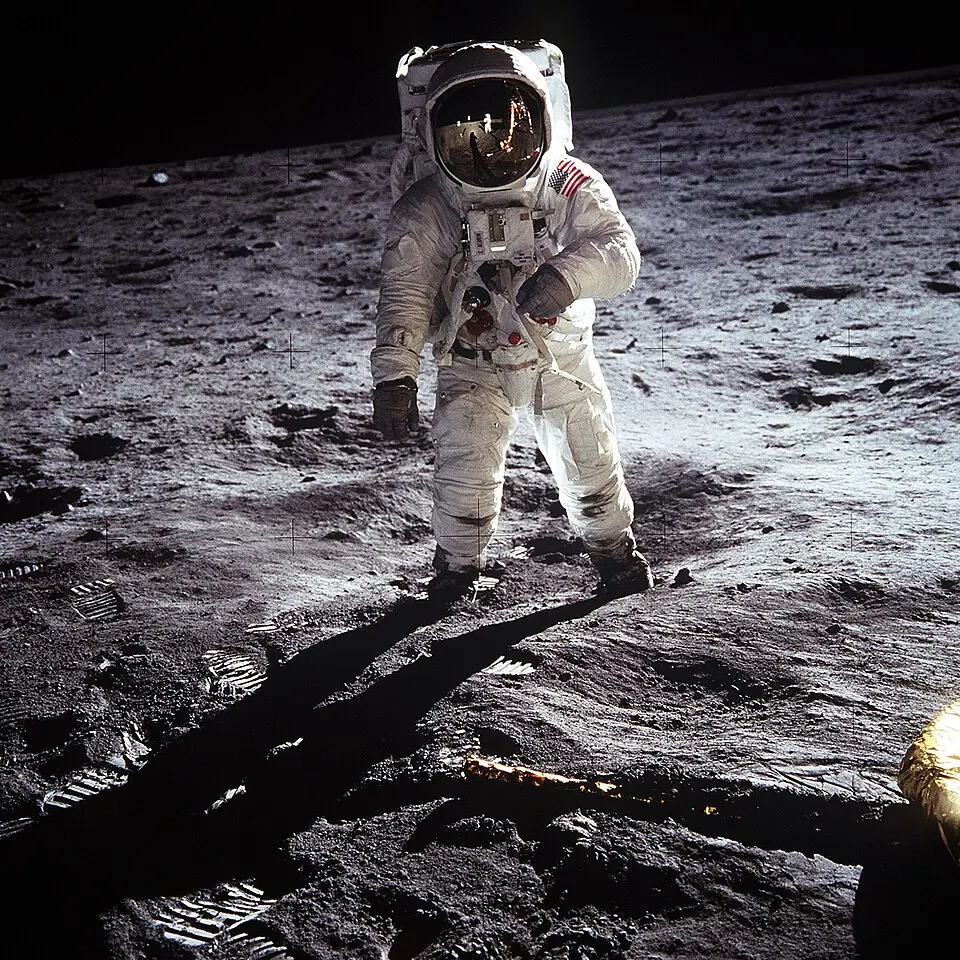
On 20 July 1969, the lunar module Eagle landed in the Sea of Tranquillity, and Neil Armstrong and Buzz Aldrin walked on the Moon while Michael Collins stayed in orbit.
On 20 July 1969 at 20:17 UTC, the lunar module Eagle of the Apollo 11 mission lands in the Sea of Tranquillity; Neil Armstrong and Buzz Aldrin walk on the surface while Michael Collins remains in orbit aboard the command module. The excursion lasts about two and a half hours and returns 21.5 kilograms of rock, instruments being left in place. These samples have a chronological function: the Moon, devoid of rain, wind and tectonics, preserves a surface that the Earth has erased, and laboratory dating of the rocks supplied the age of the craters surrounding them. Crater counting has since served as a clock for other bodies of the solar system, the age of a surface being read from the number of impacts it carries.
Why it matters
Twelve years separate the first artificial satellite from this walk, and sixty-six years separate it from the first powered flight. The event thus supplies the most direct measure of twentieth-century technical acceleration, in a species whose economy was that of hunting and gathering for most of its existence. The Moon remains to this day the only extraterrestrial ground trodden by a human being.
Dating & uncertainty
The landing is dated to the second, which distinguishes this entry from most others: the dates on this timeline generally carry an uncertainty of several centuries or millennia.
Our species’ history as one day
23:59:4415.6 s before midnight
if the 315,000 years of Homo sapiens were compressed into a single day