EVOLUTION
The First Tetrapods on Land
~390 million years ago
Phanerozoic · Paleozoic · Devonian
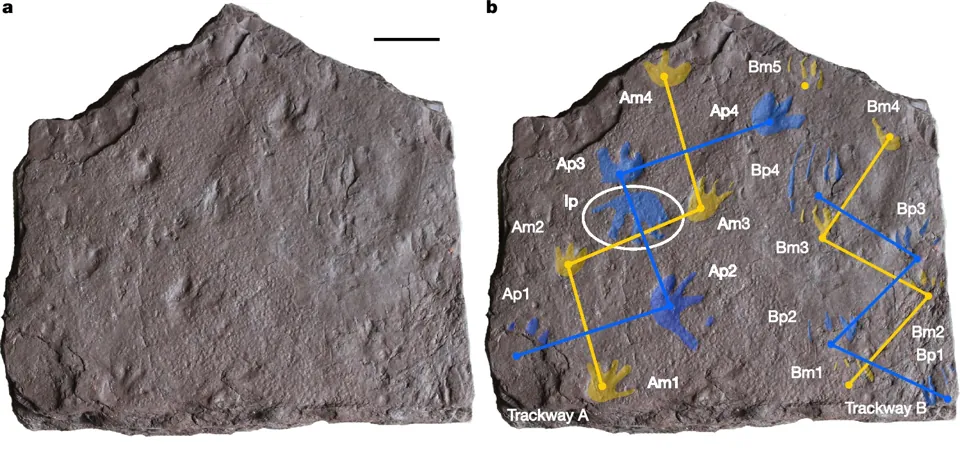
Tetrapods, the four-limbed vertebrates, left their oldest known trace as footprints on a tidal flat at Zachelmie, in Poland, about 390 million years ago, eighteen million years before the oldest bones of such an animal.
Tetrapods are the four-limbed vertebrates. Their oldest known trace is a set of footprints. In a quarry at Zachelmie, in Poland, the rock preserves trails of footprints that four-legged vertebrates left while crossing a tidal flat, a shore that the tide covers and uncovers. These footprints are eighteen million years older than the oldest bones of such an animal. They are also ten million years older than the fish long thought to have preceded tetrapods. These fish are documented too. One of them, Tiktaalik, had a shortened skull, a mobile neck and a pectoral fin, the front fin, containing a wrist that could bend and bear weight.
Why it matters
All the vertebrates that walk on the continents, amphibians, reptiles, birds, mammals and the human species, descend from the animals that made a single move from water to land. The fin became a limb, and that limb has changed form many times without ever being replaced. The footprints now date the move before any bone. The fossil record of the Devonian period is therefore far more incomplete than researchers had estimated.
Dating & uncertainty
The origin of tetrapods falls between the Early and the Late Devonian, depending on which evidence counts most. The footprints are the oldest evidence and the bones are much younger. A footprint without the animal that made it cannot be assigned to a species. Long and colleagues (2025) described Australian footprints that make the first fully land-adapted vertebrates older still, which shortens the whole transition from water to land.
Earth history as one day
21:56:172 h 4 min before midnight
if Earth’s 4.54 billion years were compressed into a single day