LIFE × EVOLUTION
The First Animals on Land
~425 million years ago (clocks suggest earlier)
Phanerozoic · Paleozoic · Silurian
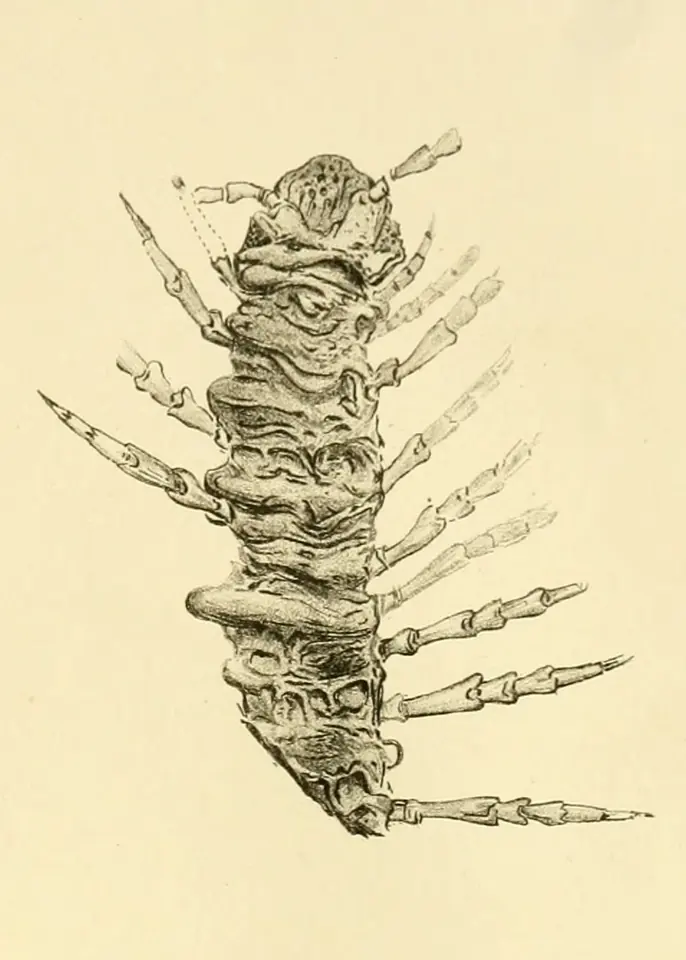
The oldest body fossil of an animal living out of water, that is, a fossil of the animal itself and not of its footprints or burrows, is a millipede from the Scottish island of Kerrera, about 425 million years old.
Kampecaris, a millipede recovered from the Scottish island of Kerrera and about 425 million years old, is the oldest body fossil of an animal living out of water. Myriapods, hexapods and arachnids each moved onto land independently. Myriapods are the millipedes and centipedes. Hexapods are the insects and their close relatives. Arachnids are the spiders, scorpions and their relatives. Molecular phylogenies, family trees reconstructed from genes, make a direct route from the sea the most probable for all three, rather than an ascent through fresh water. Molecular clocks estimate dates from the differences between the genes of living species. They place the three transitions earlier than the oldest body fossils, which is the usual relation between clocks and fossils.
Why it matters
Terrestrial ecosystems become observable about 425 million years ago, with small arthropods, animals with jointed legs, consuming dead plant matter in damp environments. How much older the land arthropods are is the open question. Molecular clocks place the emergence of myriapods in the Cambrian, possibly before there were terrestrial plants to consume. The fossils are a hundred million years younger. Early continental deposits are rare enough that the gap may be a gap in the fossil record, the set of fossils found so far.
Dating & uncertaintyDisputed
The oldest body fossil of a land animal is a millipede from Kerrera, in Scotland, about 425 million years old. Molecular clocks place the move onto land in the Cambrian or the Ordovician, two older periods, up to a hundred million years earlier. The gap between fossils and clocks is unresolved.
Earth history as one day
21:45:112 h 15 min before midnight
if Earth’s 4.54 billion years were compressed into a single day