CLIMATE × EARTH
The Gaskiers Glaciation
~581 to 580 million years ago
Proterozoic · Neoproterozoic · Ediacaran
The Gaskiers glaciation is an ice age of about 580 million years ago, dated to within a million years, during which ice reached middle and low latitudes for a third time but did not cover the planet.
The Gaskiers glaciation is the third episode in which ice reached middle and even low latitudes, after the two snowball glaciations. Unlike them, it did not cover the planet. In Newfoundland, the glacial debris lies between beds of volcanic ash dated to 580.9 and 579.9 million years ago. The dates come from zircons, crystals formed in the magma and found in the ash. Uranium-lead measurement, which uses the decay of uranium into lead, gives the moment of their eruption and therefore of the deposition of the ash. One of the glacial units, the bodies of debris left by the ice, accumulated in at most 340,000 years, far short of the millions of years the snowball hypothesis requires. A pale carbonate cap overlies each of the two snowball glaciations, and none overlies the Gaskiers deposits.
Why it matters
The first large Ediacaran fossils, the remains of soft-bodied organisms, appear less than ten million years after the Gaskiers glaciation. This brief cold episode is therefore the principal candidate for the trigger of the rise of animals. For the same reason, it is the best case on which to test the idea that a cold episode triggers anything.
Dating & uncertaintyDisputed
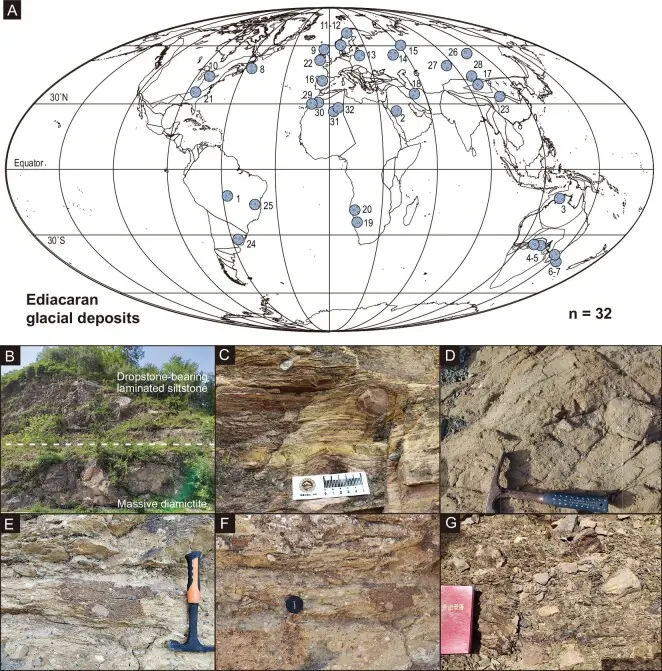
In Newfoundland, volcanic ash beds dated to 580.90 and 579.88 million years ago lie below and above the diamictite, a rock made of unsorted debris, here left by ice. One of the glacial units accumulated in at most 340,000 years, far too short for a snowball Earth. Wang and colleagues (2023) propose a competing reading. They gather some thirty glacial deposits of the Ediacaran period, distributed worldwide, into a single ice age that followed the movement of the continents from 580 to 560 million years ago. In that case, the Newfoundland dates apply to the Newfoundland episode alone.
Earth history as one day
20:55:443 h 4 min before midnight
if Earth’s 4.54 billion years were compressed into a single day