EARTH × CLIMATE
The Franklin Large Igneous Province
~720 to 717 million years ago
Proterozoic · Neoproterozoic · Cryogenian
The Franklin large igneous province is one of the largest volcanic episodes known, in which magma forced its way through the crust of what was then equatorial Canada between 720 and 717 million years ago.
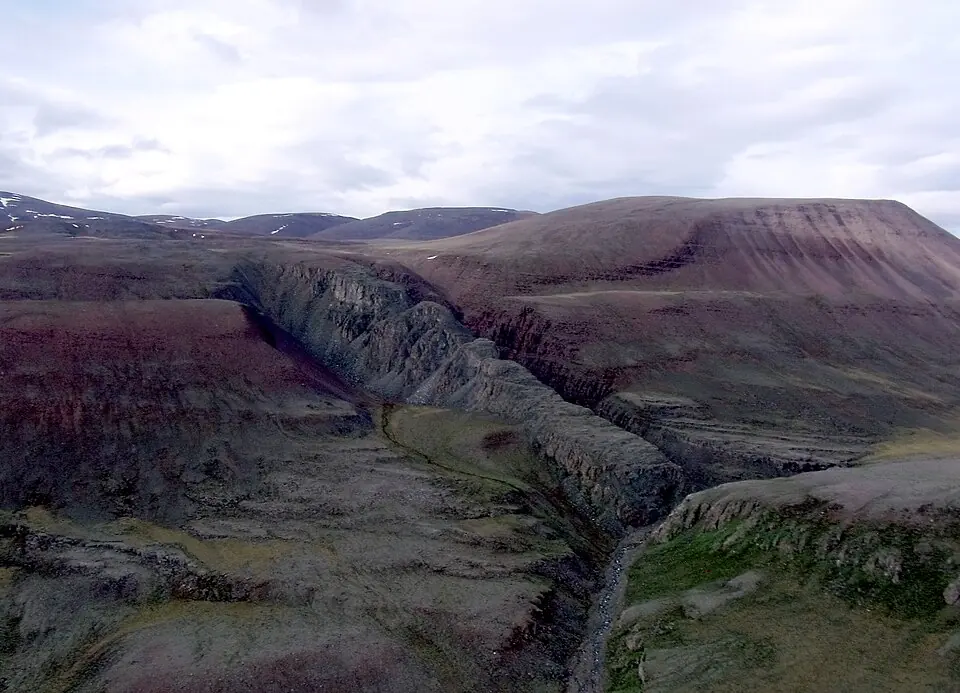
The Franklin large igneous province is a vast body of igneous rock, that is, rock formed from magma. The magma forced its way through the crust of what was then equatorial Canada, on a scale that the geological record matches only a handful of times. Eruptions also occurred in Siberia and South China in the same interval. Uranium-lead dating measures the decay of uranium into lead in a rock. Applied to the rock formed by the magma, it places the episode between 719.9 and 718.6 million years ago. Between 0.9 and 1.6 million years after the episode, ice reached sea level near the equator. The proposed link between the eruptions and the ice is chemical. Basalt, the dark rock that lava forms, weathers rapidly when fresh: rain breaks it down, and this weathering consumes atmospheric carbon dioxide. A vast area of new basalt in the wet tropics can therefore cool the planet.
Why it matters
Volcanoes ordinarily warm the planet by degassing, that is, by releasing carbon dioxide. The Franklin episode appears to have cooled it instead, and gradually. The eruptions may have raised highlands in the humid equatorial belt. Under rain, fresh basalt weathers and removes carbon dioxide from the atmosphere faster than almost any other rock. Once enough carbon dioxide has been removed, ice, which reflects solar radiation, completes the cooling.
Dating & uncertainty
Uranium-lead dating of the Franklin sills, sheets of solidified magma, gives 719.86 million years ago to within 0.21 and 718.61 to within 0.30. These ages are 0.9 to 1.6 million years older than the ice near the equator. The dating is precise, and the causal chain is not established. The cooling may come from the weathering of fresh basalt or from stratospheric sulfate aerosols, fine sulfur-bearing particles suspended high in the atmosphere. Researchers have simulated both mechanisms and observed neither.
Earth history as one day
20:11:373 h 48 min before midnight
if Earth’s 4.54 billion years were compressed into a single day