LIFE × EVOLUTION
The First Animal Trails
~560 to 539 million years ago
Proterozoic · Neoproterozoic · Ediacaran
The first animal trails are surface trails and shallow burrows left in sediment between 560 and 539 million years ago by the first animals that moved, before animals had bodies hard enough to fossilise.
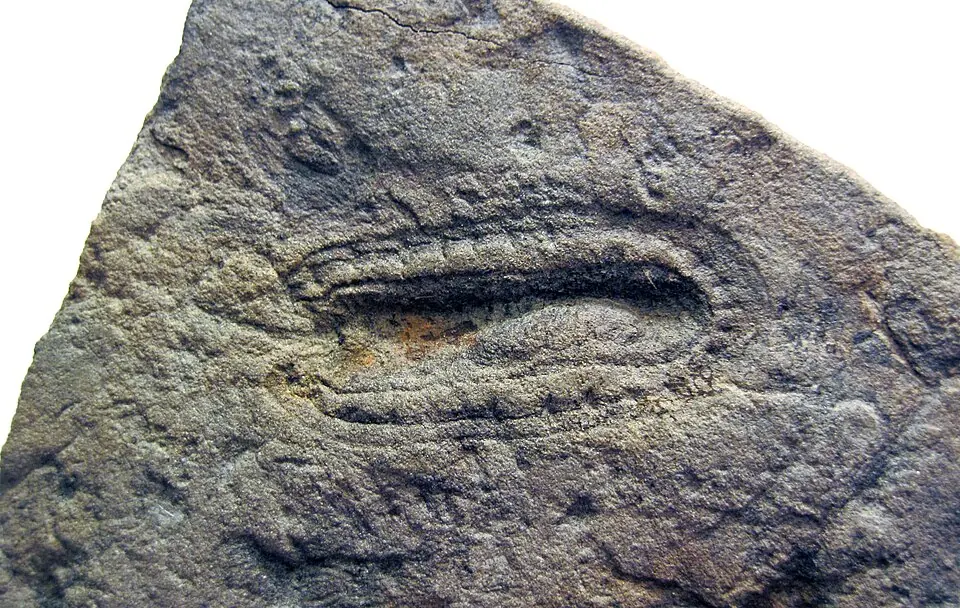
Trace fossils are the marks left by an organism rather than its body, and they are the first record of animal movement. They are older than any body hard enough to fossilise. They include trails across microbial mats, layers of microbes that covered the sediment, and burrows barely below the surface. They also include fans of paired scratches, made where an animal scraped a patch clean and moved on. All these traces are shallow: the animals of the Ediacaran, the geological period before the Cambrian, worked at the sediment surface or just beneath it. The complexity of the traces, their depth and the indications of hunting increase only at the very end of the Ediacaran. Kimberella, an Ediacaran animal, was found at the end of its own scratch marks. Because the body and the trace are associated, Kimberella is the first animal whose behaviour can be reconstructed.
Why it matters
A trail establishes three things that a fossil of the body does not: muscles that propelled the animal, an anterior end, the front of the body, that directed its movement, and a choice of direction. Bilaterally symmetrical animals, whose left and right halves mirror each other, were already choosing a direction before the Cambrian. These abilities are therefore older than the Cambrian explosion, the rapid diversification of animals during that period. The explosion quickly added a repertoire of ways of exploiting the sediment that Ediacaran traces do not show.
Dating & uncertainty
A genuine trail is difficult to distinguish from the fossil of a tube-shaped body, and researchers have reinterpreted several fossils presented as Ediacaran traces. The least contested are the traces described from the Dengying Formation, a named succession of rock layers, and the paired scratch marks of Kimberella.
Earth history as one day
21:02:222 h 58 min before midnight
if Earth’s 4.54 billion years were compressed into a single day