LIFE × EVOLUTION
Cloudina and the First Skeletons
~550 million years ago
Proterozoic · Neoproterozoic · Ediacaran
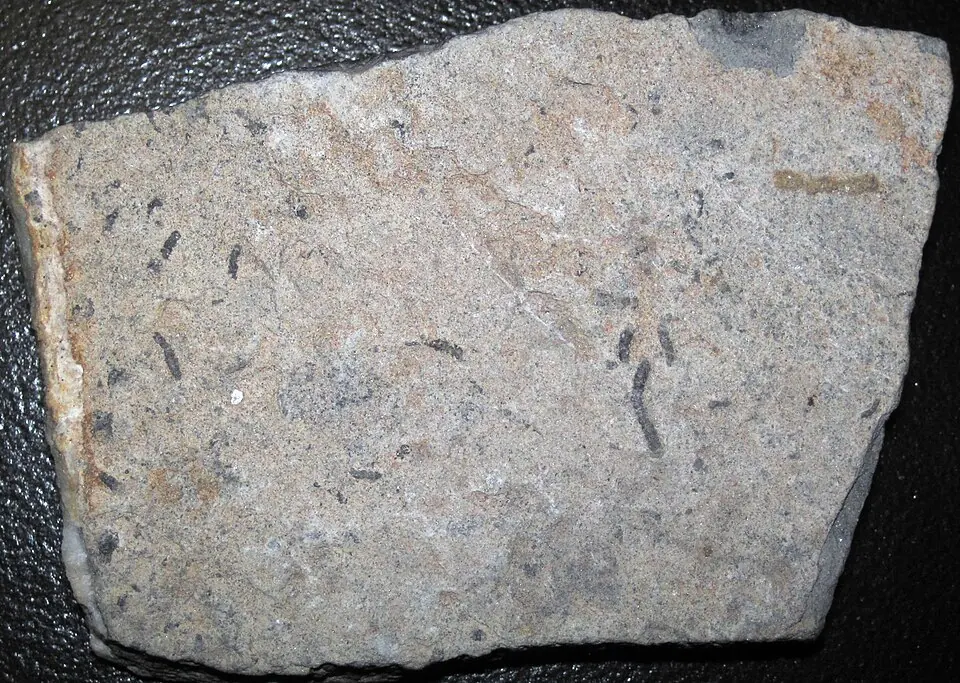
Cloudina was an animal that built one of the first large animal skeletons, a stack of calcareous funnels, made of the mineral of limestone, fitted one inside the next, about 550 million years ago.
Cloudina is a fossil animal whose skeleton is a stack of calcareous funnels, made of calcium carbonate, the mineral of limestone, fitted one inside the next. Some of these shells are pierced by boreholes, which researchers take for the marks of a predator. Skeletons therefore appear together with the first direct evidence of animals eating animals. The usual reading links the two: a shell is a response to being eaten. These skeletons appear in shallow tropical seas supersaturated with carbonate, the dissolved ingredient of limestone. Supersaturated water holds more dissolved carbonate than it can retain. Mineral precipitates readily from it, that is, leaves solution as a solid, and a skeleton costs an organism comparatively little.
Why it matters
A protective skeleton presupposes attackers, and the chemistry of the water determines its cost. The two conditions, predators and favourable water chemistry, come together in the last ten million years of the Precambrian, the time before the Cambrian period. Mineralised skeletons, hardened with mineral, then appear simultaneously in several unrelated groups. This may be the beginning of the Cambrian arms race, in which predators and prey evolve ever stronger attacks and defences.
Dating & uncertainty
Mineralised plates, probably produced by protists, which are mostly single-celled organisms, are known from about 810 million years ago. Large animal skeletons appear later, only around 550 million years ago, with Cloudina. The trigger of these skeletons is not established. Three are proposed: seawater chemistry, a rise or a stabilisation of oxygen, and predation. The three are not exclusive.
Earth history as one day
21:05:332 h 54 min before midnight
if Earth’s 4.54 billion years were compressed into a single day