LIFE × EVOLUTION
The Ediacara Biota
~575 to 539 million years ago
Proterozoic · Neoproterozoic · Ediacaran
The Ediacara biota was a community of large soft-bodied organisms, fronds, discs and ribbed ovals, that lived in the sea between 575 and 539 million years ago and resembled no later organism.
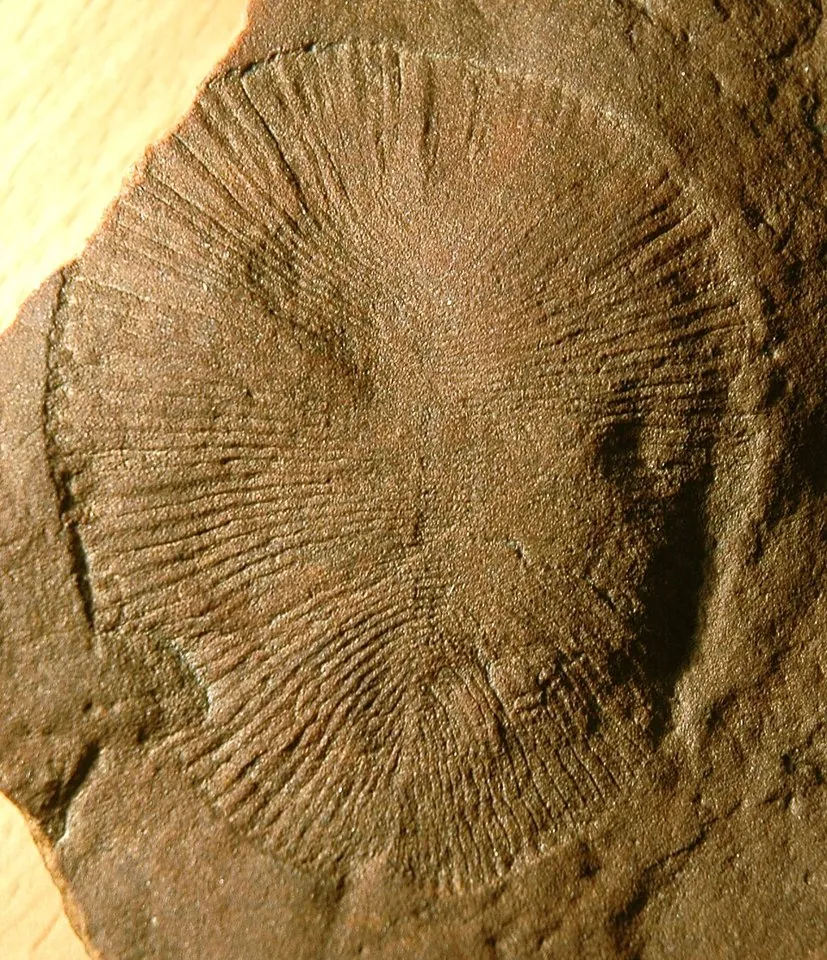
The Ediacara biota is a group of large, complex, soft-bodied organisms, none of them shaped like any organism that followed. Some were fronds anchored in the mud, others flat quilted discs, with a surface divided into padded segments like a quilt. Others were ribbed ovals that lay on microbial mats, layers of microbes growing on the sediment, and fed from them. Bobrovskiy and colleagues (2018) extracted fossil cholesterol from one of these organisms, Dickinsonia. Animals produce cholesterol, and fungi and algae do not, so Dickinsonia at least was an animal. The biota occurs as three successive assemblages, groups of fossil forms found together, named Avalon, White Sea and Nama after the regions where each was first described. Four fifths of the known forms disappear between the White Sea assemblage and the Nama assemblage.
Why it matters
For thirty million years the sea contained large organisms that most living groups do not help to interpret. Midway through those thirty million years the community reorganised: it came to include animals that moved, competed for space and reproduced in complex ways. The loss of forms that followed reaches the scale of the later great extinctions. The Cambrian, the geological period that came next, succeeded a living world that was already changing.
Dating & uncertainty
Soft-bodied fossils are rare, and their affinities, meaning the groups to which they are related, are contested. Cholesterol serves as a biomarker, a molecule that reveals the kind of organism that produced it. Its presence establishes Dickinsonia and its close relatives as animals. The rest of the biota remains undetermined: researchers have interpreted it as everything from large single-celled protists to terrestrial lichens.
Earth history as one day
20:57:373 h 2 min before midnight
if Earth’s 4.54 billion years were compressed into a single day