LIFE × EVOLUTION
The Doushantuo Embryos
~609 million years ago
Proterozoic · Neoproterozoic · Ediacaran
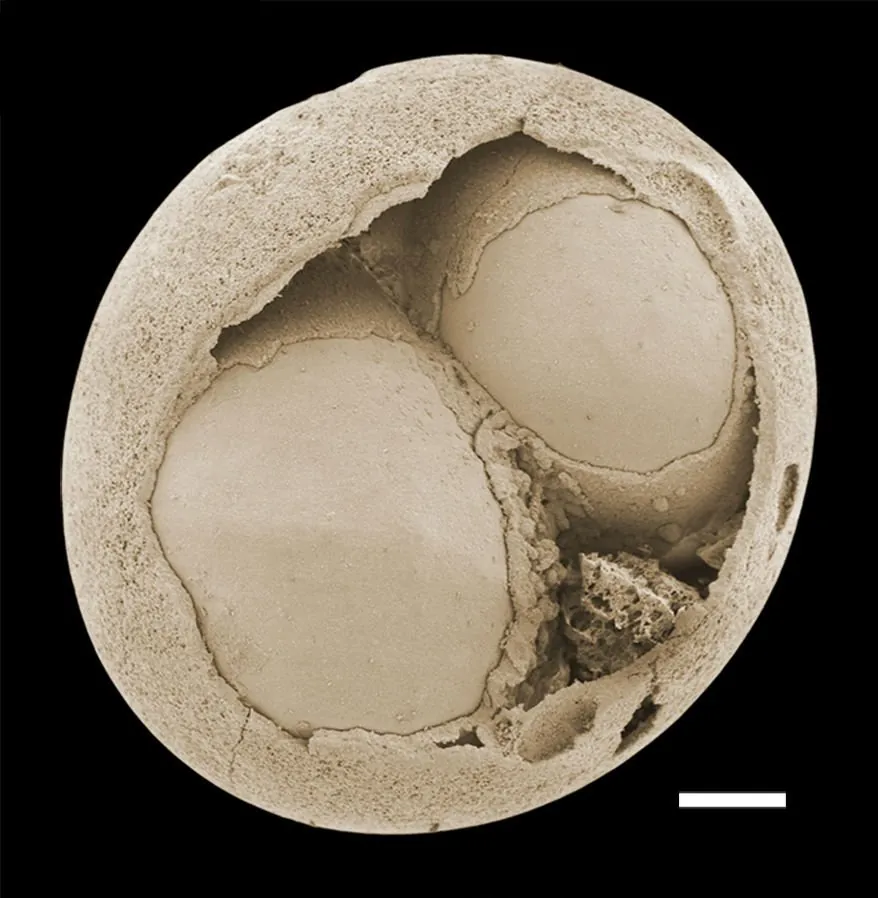
The Doushantuo fossils are spheres a few tenths of a millimetre across, about 609 million years old, found in South China and preserved while dividing into two, four and eight cells.
The Doushantuo fossils are clusters of cells preserved in the phosphate rock of South China. Each is a sphere a few tenths of a millimetre across, fossilised while dividing into two, four and eight cells. Researchers examined them by synchrotron X-ray tomography, a method that uses the intense X-rays of a particle accelerator to image the interior of a specimen without breaking it. They sorted the fossils into four distinct division patterns. They also identified late stages in which certain cells are set apart from the rest. This is the separation of a germ line, the cells that give rise to the next generation, from the body of the organism. In one of the four patterns, the cell divides on one side only, and this pattern occurs in animals and nowhere else.
Why it matters
The Doushantuo fossils are the only ones of this age in which multicellular development, the building of a body by cell division, is observed and not inferred. They are more than thirty million years older than the first Ediacaran fossils, which are large soft-bodied organisms. Their identity remains disputed: algae, stem animals, which are extinct early relatives of animals, or something else. The dispute now concerns which group of multicellular eukaryotes, organisms whose cells have a nucleus, they belong to, and no longer whether they were multicellular.
Dating & uncertaintyDisputed
Researchers have argued for twenty-five years over what the Doushantuo fossils are: sulfur bacteria, protists, which are single-celled organisms with a nucleus, algae or animal embryos. Tomography now demonstrates cell differentiation, cells becoming unlike one another, and several distinct cleavage patterns, the patterns of cell division. This narrows the hypotheses but leaves more than one open.
Earth history as one day
20:46:503 h 13 min before midnight
if Earth’s 4.54 billion years were compressed into a single day