EARTH × CLIMATE
The Ordovician Meteorite Shower
~468 to 466 million years ago
Phanerozoic · Paleozoic · Ordovician
A large asteroid broke apart in the main asteroid belt about 466 million years ago, and its debris has been falling ever since, and about a third of the meteorites reaching the Earth today still come from that asteroid.
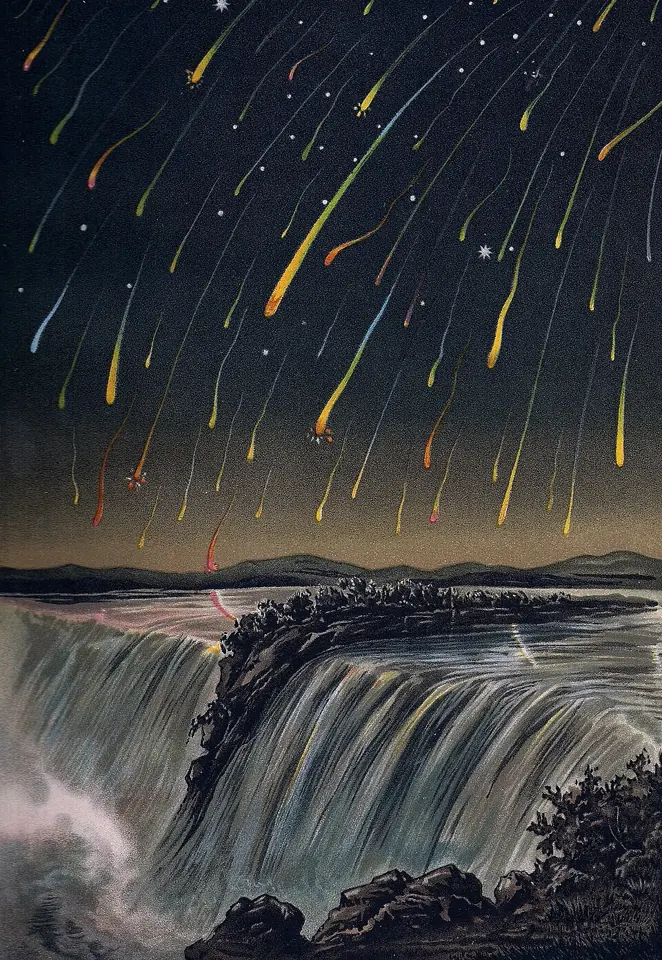
The Ordovician meteorite shower is the fall of debris that followed the break-up of a large asteroid about 466 million years ago. The asteroid broke apart in the main belt, the zone where most asteroids orbit the Sun, and its debris has been falling ever since. About a third of all meteorites reaching the Earth today still come from that single body. Swedish limestone of that age is crowded with fossil meteorites, stones that fell into the sediment and were preserved within it. The flux of the finest dust, the quantity arriving on the Earth, rose by three to four orders of magnitude, that is, by a factor of a thousand to ten thousand, and stayed high for more than two million years after the break-up.
Why it matters
An event in the solar system rarely leaves so clear a trace in sedimentary rock, rock formed from deposited sediment. Researchers disagree on the effects of the dust on the Earth. Schmitz and colleagues (2019) hold that the dust acted as a screen and tipped the Ordovician into an ice age. Lindskog and colleagues (2017) dated the beds precisely and concluded that the break-up and the biological changes of the same period are unrelated.
Dating & uncertaintyDisputed
Zircon, a mineral datable by its uranium, from the meteorite-bearing beds of southern Sweden places the break-up 468.0 million years ago, to within 0.3. Other work keeps the younger date of 466 million years ago. It rests on extraterrestrial chromite, mineral grains that come from meteorites, and on helium-3, a rare form of helium brought by dust from space. Opinion is more divided on the effects of the dust than on the date of its fall. On one reading the dust brought cooling and falling sea level, on the other no visible effect in the biological record.
Earth history as one day
21:31:332 h 28 min before midnight
if Earth’s 4.54 billion years were compressed into a single day