GENETICS
Mendel's Rules of Inheritance
1866 CE
Phanerozoic · Cenozoic · Quaternary · Holocene · Meghalayan
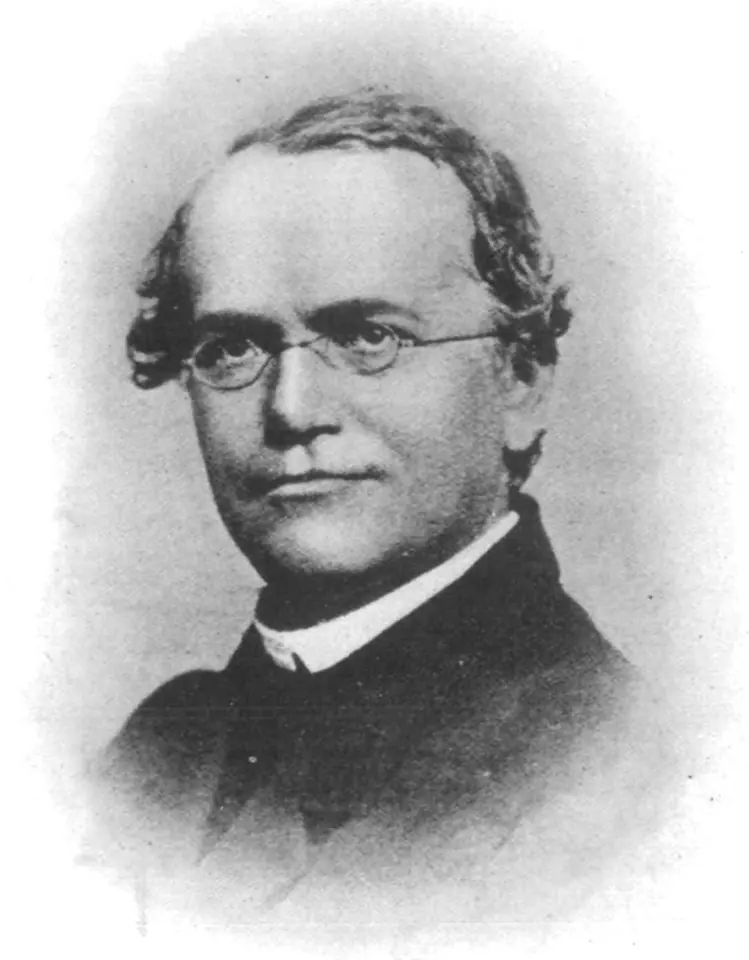
Gregor Mendel counted pea plants for eight years and established in 1866 that traits do not blend in inheritance but are passed on as discrete units that separate and recombine.
Mendel's rules of inheritance describe how traits pass from parents to offspring. Gregor Mendel counted pea plants for eight years and established that inheritance does not blend the traits of the parents. Traits are passed on as discrete units, later called alleles. The units separate when gametes, the reproductive cells, form, a process called segregation. They recombine in the next generation. A trait may therefore disappear in one generation and reappear intact in the following one. Mendel published his results in 1866, and the paper was cited four times in the next thirty-four years.
Why it matters
Darwin's theory of natural selection required that inheritance should not blend, and Darwin did not have this result. If inheritance worked by blending, every new variation would be halved at each generation, and natural selection would have no variation left to act on. Mendel's paper was in print seven years after On the Origin of Species, and none of those who needed its result read it.
Dating & uncertainty
The experiments ran from 1856 to 1863, and the paper appeared in 1866. It was cited four times over the following thirty-four years, and its significance was recognised only after 1900.
Earth history as one day
23:59:59.99703.0 ms before midnight
if Earth’s 4.54 billion years were compressed into a single day