EARTH × TECHNOLOGY
Naming the Geological Periods
1815 to today
Phanerozoic · Cenozoic · Quaternary · Holocene · Meghalayan
The names of the geological periods, such as Cambrian, Jurassic and Cretaceous, were coined one at a time from 1815 by geologists who could order the layers of rock long before they could date them.
The geological time scale divides the Earth's history into named periods, shown on the strip below this timeline. Names such as Cambrian, Jurassic and Cretaceous were coined one at a time, from a Welsh tribe, a French mountain range and English chalk. The geologists who coined them could place the layers of rock in order long before they could give any layer an age in years. The ordering rests on the principle of faunal succession: each layer contains its own set of fossils, called a fossil assemblage, and the same layer always contains the same assemblage. Layers in distant regions can therefore be matched by their fossils alone. The discipline built on this principle is biostratigraphy. Biostratigraphy supplied the whole relative time scale, the order of the layers. Radiometric dating, which measures the decay of radioactive elements in rock, later supplied the absolute scale, the ages in years.
Why it matters
The period names form a shared vocabulary, so a fossil uncovered anywhere on the globe can be placed in a single sequence. The coloured column on this page is built from these names. The limits between periods still move as dating improves. The periods are a convention, adopted and then revised, applied to layers of rock that have no divisions of their own.
Dating & uncertainty
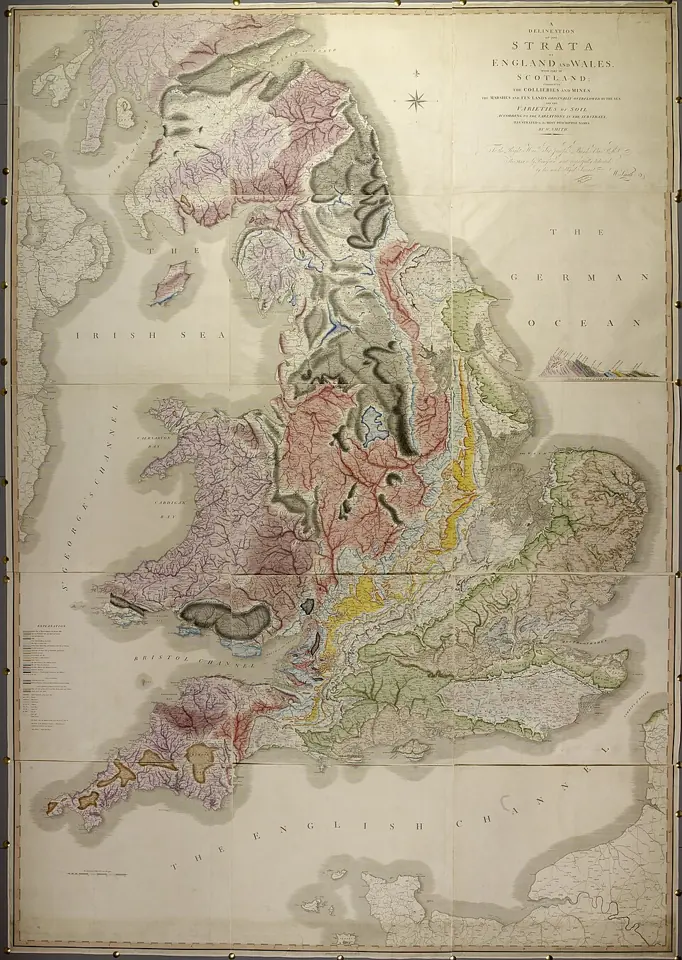
The first geological map of a whole country appeared in 1815, and the period names followed one at a time through the nineteenth century. The geological time scale has been under revision ever since, which is why the date of this entry runs to today.
Earth history as one day
23:59:59.99604.0 ms before midnight
if Earth’s 4.54 billion years were compressed into a single day