LIFE × EVOLUTION
The First Animals
~800 million years ago (claims 890 to 635 Ma)
Proterozoic · Neoproterozoic · Tonian
The earliest animal was most likely a sponge, and the two fossil candidates, one from 890-million-year-old Canadian reefs and one from the end of the Ediacaran period, lie some 350 million years apart.
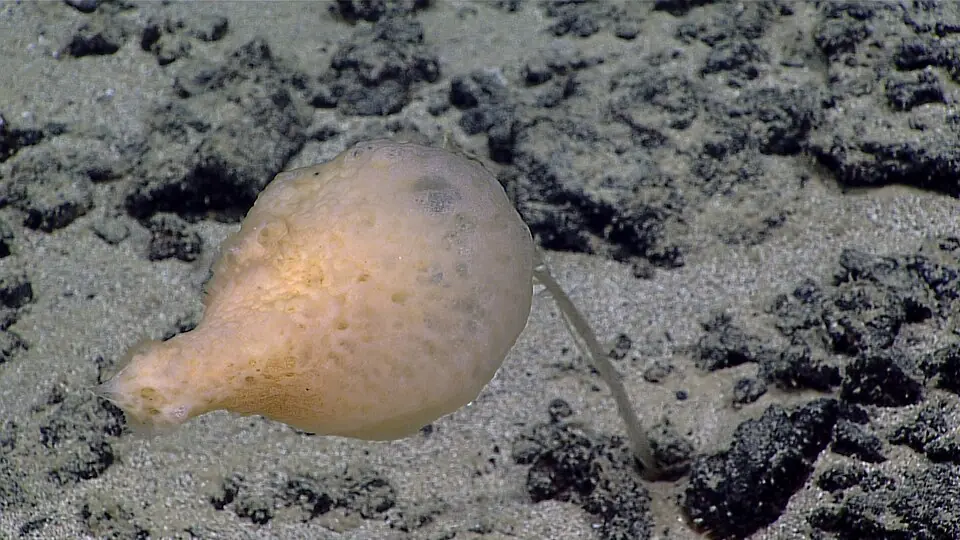
Sponges occupy the base of the animal tree, the branch that separated first, so the search for the earliest animal is largely a search for a sponge. Two fossil candidates, some three hundred and fifty million years apart, show how difficult a sponge is to identify. In 890-million-year-old Canadian reefs, a mesh of worm-like tubes threads through the rock exactly as the decayed skeleton of a horny sponge does, a skeleton made of spongin, a protein rather than a mineral. Turner (2021) reads the mesh as a possible sponge, and other authors read it as a purely mineral growth. The second candidate dates from the close of the Ediacaran, the geological period before the Cambrian, around 551 to 539 million years ago. It is a goblet-shaped fossil from South China, more than forty centimetres tall, and its identification is not disputed. Phylogenetic analysis, the reconstruction of lines of descent, places it within the sponge crown group, the group comprising the last common ancestor of living sponges and all of its descendants. Its skeleton is organic and not mineral, which is why sponges older than this fossil are so hard to detect.
Why it matters
If the 890-million-year-old mesh is a sponge, animals were present before the second rise of oxygen and passed through the global glaciations. The Ediacaran fossil alone establishes that an animal without mineralised parts leaves scarcely any trace in rock. The Cambrian explosion, the sudden appearance of most animal groups in the fossil record, is therefore in part an explosion in what fossilises.
Dating & uncertaintyDisputed
Molecular clocks, which date the branching of lineages from the differences between their genes, place the origin of animals well before the Cambrian. The fossils are contested. Some authors read the sponge-like structures in the 890-million-year-old reefs as the oldest animal bodies, others as mineral artefacts, shapes that minerals form without any organism. The first crown-group sponge accepted without argument dates from the end of the Ediacaran.
Earth history as one day
19:46:154 h 14 min before midnight
if Earth’s 4.54 billion years were compressed into a single day