LIFE × EVOLUTION
The First Fungi
~1 billion to 715 million years ago
Proterozoic · Neoproterozoic · Tonian
The earliest fossils attributed to fungi come from two finds, in Arctic Canada and in the Congo, dated between 1 billion and 715 million years ago, in the Proterozoic, the eon that precedes the present one.
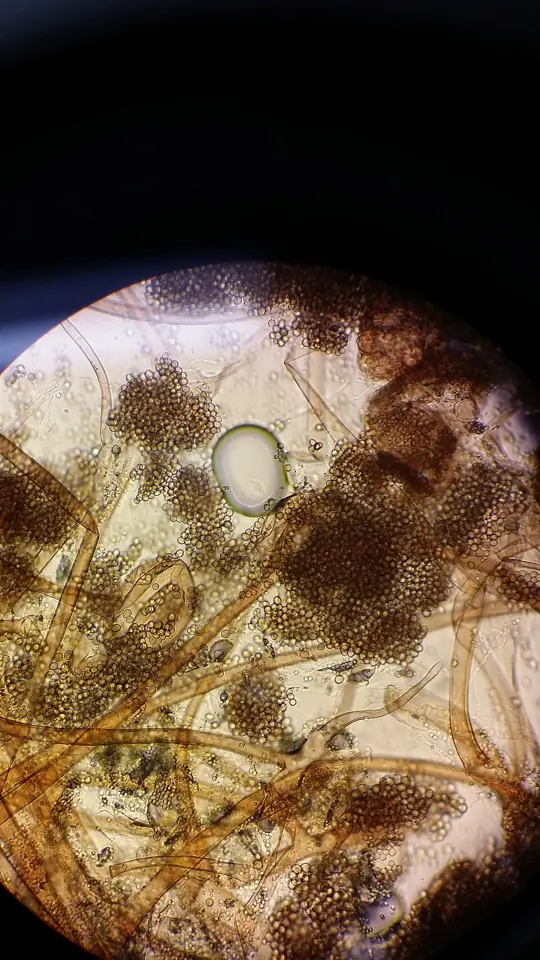
Fungi are organisms that leave almost nothing in the fossil record: no shell, no wood, only filaments called hyphae. Two finds nonetheless show fungi deep in the Proterozoic. The first consists of microfossils, fossils of microscopic size, from Arctic Canada, 1,010 to 890 million years old. Loron and colleagues (2019) attributed them to fungi on their shape and the chemistry of their wall, and the attribution is disputed on those same grounds. The second find consists of filaments from the Congo, 810 to 715 million years old. They branch at wide angles into dense networks and still retain traces of chitin, the characteristic material of a fungal wall. These Congo filaments grew on ground periodically exposed to the air.
Why it matters
Fungi probably played a determining role in the colonisation of the continents. They decompose dead matter, and they would later supply the roots of plants with minerals in exchange for sugars. The Proterozoic fossils show fungi at the water's edge several hundred million years before the first plant. Decomposers were therefore in place when plants reached dry land.
Dating & uncertainty
The microfossils from Arctic Canada, 1,010 to 890 million years old, are interpreted as fungi from their shape and chemical composition, and this attribution is debated. The Congo filaments, 810 to 715 million years old, retain traces of chitin, which is a firmer argument. If the Canadian microfossils are set aside, the fossil record of fungi begins 810 million years ago.
Earth history as one day
18:42:495 h 17 min before midnight
if Earth’s 4.54 billion years were compressed into a single day