LIFE × EVOLUTION
The Small Shelly Fossils
~539 to 521 million years ago
Phanerozoic · Paleozoic · Cambrian
The small shelly fossils are cones, tubes, plates and spines a millimetre long, many of them pieces of the skeletons of larger animals, that fill the first rocks of the Cambrian period, between 539 and 521 million years ago.
The small shelly fossils are hard parts about a millimetre long, in the shape of cones, tubes, plates and spines. Researchers recover most of them by dissolving limestone in acetic acid, the acid of vinegar, which leaves intact the phosphatic pieces, those made of phosphate mineral. Many are sclerites, that is, individual elements of a composite skeleton. These sclerites belonged to larger animals whose bodies remain unknown. A few were identified decades later as the scales of animals that were eventually found complete. Together, the small shelly fossils are the first abundant hard parts in the fossil record, and they precede the trilobites, extinct marine arthropods with a hard carapace.
Why it matters
The Cambrian explosion, the rapid diversification of animals in the Cambrian, first appears in the rocks as skeletal fragments of animals as yet unnamed. The pieces come before the bodies to which they belong: researchers recover those bodies later or not at all.
Dating & uncertainty
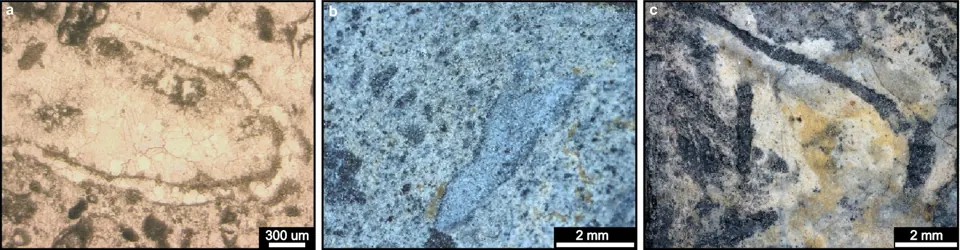
Geologists divide the basal Cambrian, its lowest part, into assemblage zones, each defined by its group of fossils. These zones are the working scale, so the interval is partly defined by the fossils themselves. Shelly microfossils claimed in Brazil by Morais and colleagues (2024) are dated to 571 million years ago, give or take 9 million. They would place the first mineralised animals, with mineral skeletons, well back in the Ediacaran, the preceding period, and before Cloudina.
Earth history as one day
21:09:062 h 51 min before midnight
if Earth’s 4.54 billion years were compressed into a single day