LANGUAGE × TECHNOLOGY
The Border Cave Tally Bone
~43,000 years ago
Palaeolithic · Upper Palaeolithic · Last glacial
A baboon bone notched with repeated marks about 43,000 years ago, at Border Cave, is the oldest known record of information kept outside the body.
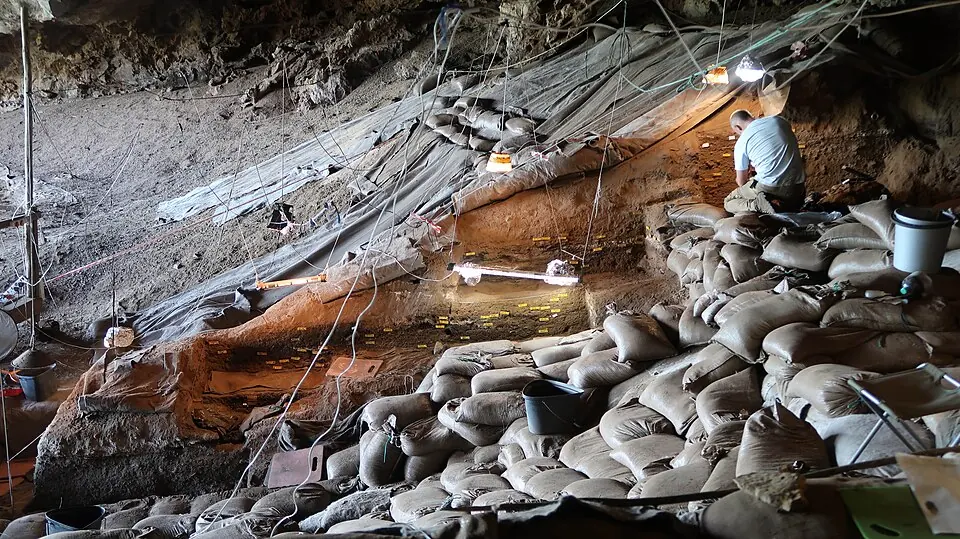
Objects bearing repeated marks constitute the oldest attested form of recording information outside the body. The principal one is a baboon fibula from Border Cave, South Africa, known as the Lebombo bone after the mountains in which the site lies, and dated to 44,000 to 42,000 years. Microscopic examination establishes that its notches were made on separate occasions and with different tools, each edge leaving a groove profile of its own. That observation grounds the interpretation: a decoration is executed in one sitting, whereas a tally accumulates, so that marks added successively over time are interpreted as counting. A bone incised by Neanderthals, in France, may carry the practice back beyond 60,000 years, and objects bearing series of marks are in common use from the beginning of the European Upper Palaeolithic.
Why it matters
The practice inaugurates a continuous technical series, from notches to accounting tokens, then to numerals and to writing, consisting in delegating memory to a material support. Comparative work on the astronomy and calendars of hunter-gatherer societies suggests that such supports constitute the condition of possibility of counting and of calendars rather than merely their record.
Dating & uncertainty
The reference object is the notched fibula from Border Cave, dated to about 44,000 to 42,000 years, whose marks were made at different times. Incisions recorded on a hyena bone from the site of Les Pradelles, in Charente, dated to 72,000 to 60,000 years and attributed to Neanderthals, may instead record numerical information in a single session. Through the Upper Palaeolithic the number of marks increases and their organisation becomes more complex.
Our species’ history as one day
20:43:253 h 17 min before midnight
if the 315,000 years of Homo sapiens were compressed into a single day