ART
The Venus of Hohle Fels
~40,000 years ago
Palaeolithic · Upper Palaeolithic · Last glacial
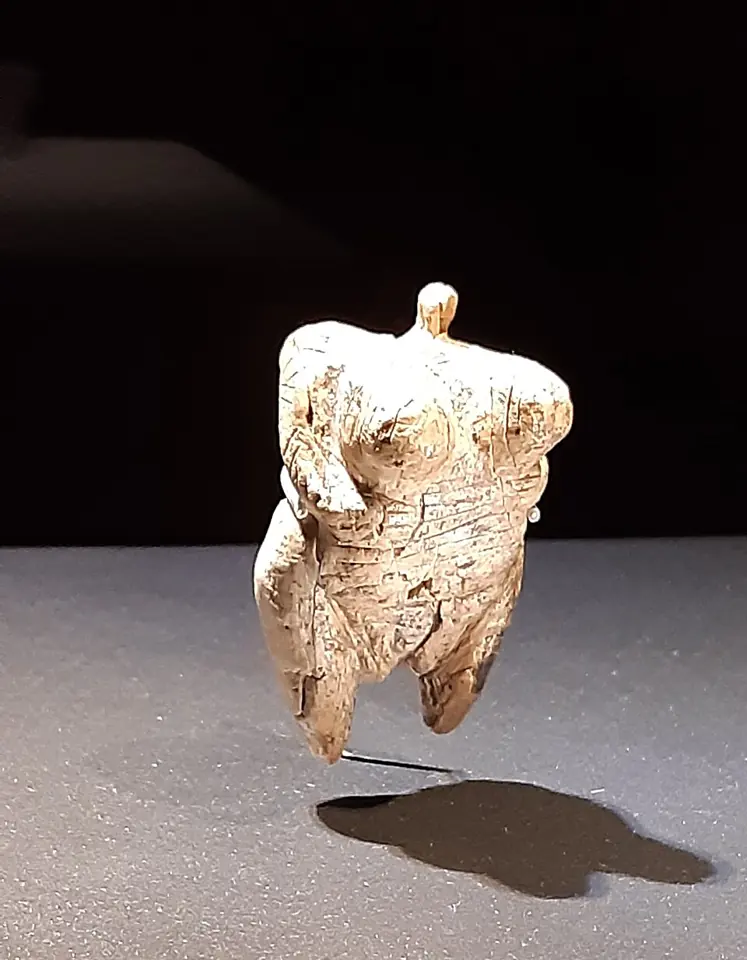
The Venus of Hohle Fels, a mammoth-ivory figurine carved in Germany about 40,000 years ago, is the oldest known representation of a human being.
The Venus of Hohle Fels is an anthropomorphic figurine of mammoth ivory discovered in 2008, in six fragments, at the base of the Aurignacian deposits of Hohle Fels Cave, in the Swabian Jura, Germany. A few centimetres tall, it presents strongly accentuated sexual characters and bears, at the position of the head, a carved ring allowing suspension. It constitutes the oldest known human representation, predating the female figurines of the Gravettian by at least five millennia.
Why it matters
The first known human representation is not a portrait but a selective accentuation of certain characters, on an object designed to be worn. It comes from the same small group of Swabian caves as the oldest known flutes and the composite figurine known as the lion-man, a concentration documenting sustained figurative production in the first millennia of the presence of Homo sapiens in Europe. The meaning of the accentuation, fertility, protective function or otherwise, cannot be determined from the object.
Dating & uncertainty
Two estimates coexist, joined by a stratigraphic argument. The excavator retains an age of at least 35,000 years. The figurine lying at the very base of the Aurignacian deposits, and an object at the bottom of a layer having the age of that layer's beginning, the redating of that beginning applies to the object: radiocarbon on purified collagen places the start of the Swabian Aurignacian around 42,500 years. The date shown falls between the two bounds the measurements support.
Our species’ history as one day
20:57:083 h 3 min before midnight
if the 315,000 years of Homo sapiens were compressed into a single day