TECHNOLOGY
Abri du Maras: the Oldest String
~41,000 years ago or more
Palaeolithic · Upper Palaeolithic · Last glacial
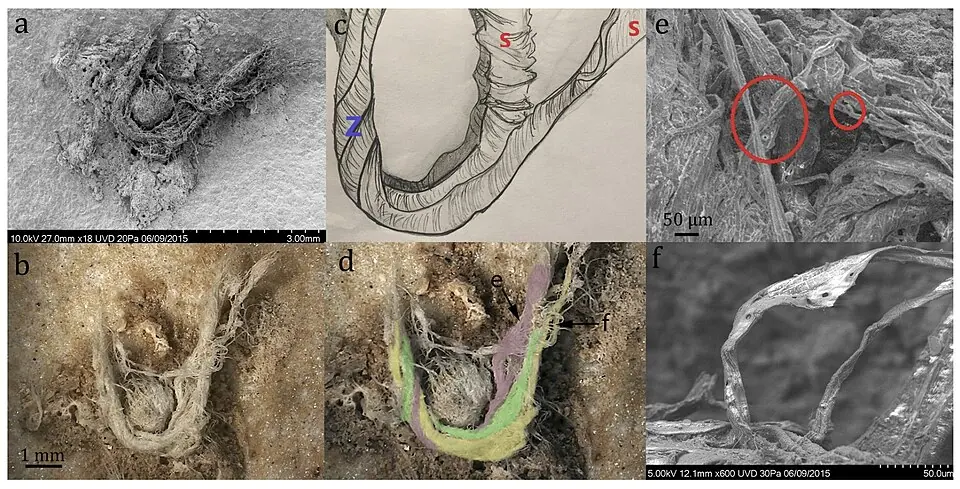
A three-ply cord a few millimetres long, preserved on a Neanderthal tool in the Ardeche, is the oldest direct evidence of string, at least 41,000 years old.
The cord from Abri du Maras, in the Ardeche, published in 2020, constitutes the oldest direct evidence for the making of string. It is a fragment a few millimetres long, of three plies of inner bark fibre, preserved on a Neanderthal stone tool. The process is plying: fibres are twisted in one direction to form strands, then the strands together in the opposite direction, each twist opposing the other and preventing the whole from unwinding. Handling several sets simultaneously in opposite directions presupposes command of series and pairs. String is the precondition of rope, bags and nets. At Dzudzuana, in Georgia, wild flax fibres are spun, dyed and knotted between 32,000 and 26,000 years ago; the eyed needles that appear later indicate finer sewing.
Why it matters
Plant materials surviving only exceptionally, the perishable part of prehistoric equipment escapes documentation almost entirely, although it is involved in hafting weapons, suspending ornaments, net fishing and building craft. A single fragment preserved in waterlogged conditions therefore alters the technical inventory attributable to whole periods, and attests a multi-component technology in Neanderthal hands.
Dating & uncertainty
The fragment comes from layers dated to about 52,000 to 41,000 years and belongs to a Neanderthal occupation. The Dzudzuana flax fibres, in the Caucasus, are dated to 32,000 to 26,000 years. The real antiquity of the technique very probably exceeds by far that of its oldest preserved witness, the probability of such a material surviving being extremely low.
Our species’ history as one day
20:52:343 h 7 min before midnight
if the 315,000 years of Homo sapiens were compressed into a single day