TECHNOLOGY
Sibudu: the First Bow and Arrow
~64,000 years ago
Palaeolithic · Middle Stone Age · Last glacial
Tiny stone points from Sibudu Cave, in South Africa, were shot from bows about 64,000 years ago, the earliest evidence of archery.
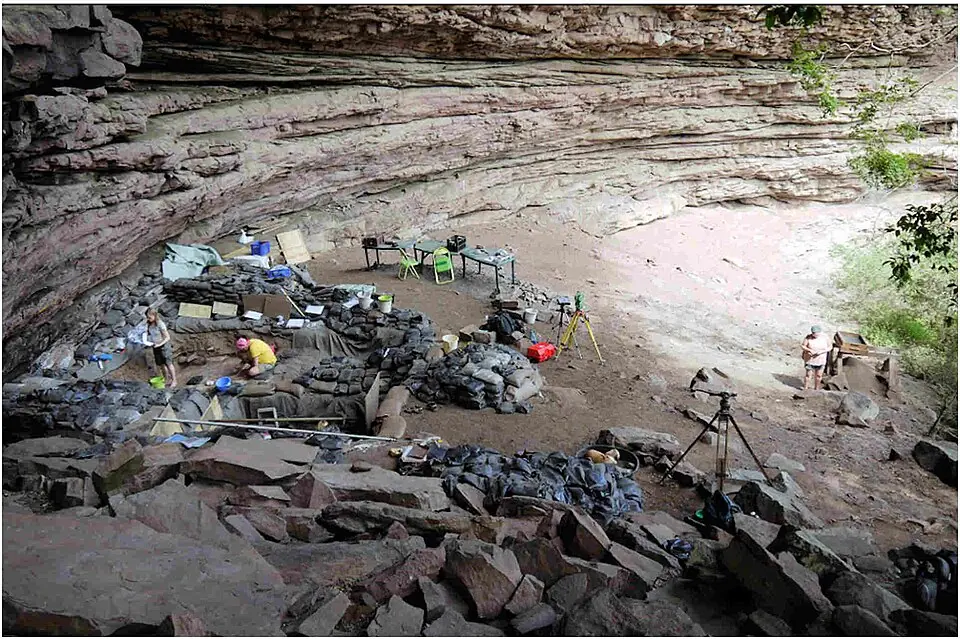
Sibudu Cave, in KwaZulu-Natal, South Africa, has yielded small crescent-shaped quartz segments bearing wear, residues and impact fractures, interpreted as armatures of arrows shot from bows around 64,000 years ago, some mounted as lateral barbs rather than as points. The first criterion is dimensional: an armature light enough to equip a thin, fast shaft is too small for a hand-thrown spear, and its mode of breakage corresponds to a high-velocity impact. No bow has been preserved for this period, the weapon being reconstructed from traces recorded on the stone and their comparison with hunting experiments.
Why it matters
The bow constitutes the oldest known device for storing mechanical energy, force applied slowly being released at once. Shooting at a distance alters the range of accessible prey and the risk incurred, and presupposes command of cords, adhesives and shafts of which nothing survives. The African location and the antiquity of the attestation shift the chronological frame ordinarily accepted for the appearance of composite technologies.
Dating & uncertainty
The Sibudu levels containing these segments are dated to 64,700 to 61,700 years by optically stimulated luminescence. The bow is inferred rather than found, wood, cord and fletching surviving only exceptionally. The demonstration rests on use traces, residues and impact fractures on armatures whose dimensions and mode of breakage accord better with arrows than with spears, compared against experimental series.
Our species’ history as one day
19:07:254 h 53 min before midnight
if the 315,000 years of Homo sapiens were compressed into a single day