ART
The Swabian Jura Bone Flutes
~42,000 years ago
Palaeolithic · Upper Palaeolithic · Last glacial
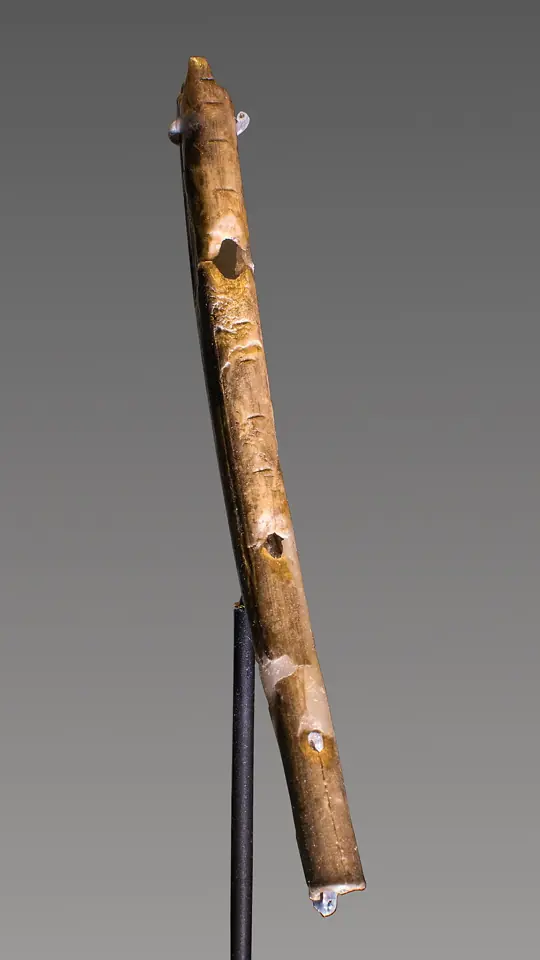
Flutes of bird bone and mammoth ivory, about 42,000 years old, were found in caves of the Swabian Jura, in Germany: no older musical instrument is known.
The flutes of the Swabian Jura, in Germany, from the caves of Geissenklosterle, Hohle Fels and Vogelherd, are the oldest known musical instruments, made about 42,000 years ago. Two materials are used: vulture wing bone, which provides a naturally hollow tube, and mammoth ivory, whose working requires splitting the tusk, hollowing each half and then rejoining them airtight, a considerably more complex operation. The same deposits have yielded some of the oldest known figurative sculptures.
Why it matters
Music leaves material traces only through its most durable instruments, which makes most of its history inaccessible. A five-holed flute implies a scale of pitches, transmitted fingerings and an audience; reproducing an instrument type in a material as difficult as solid ivory further indicates an established practice rather than isolated experimentation.
Dating & uncertainty
The instruments come from early Aurignacian levels, whose beginning radiocarbon measured on ultrafiltered collagen places around 42,500 years. The detail of the chemical treatment matters: radiocarbon measures a decaying isotope, and at forty millennia so little remains in a bone that a trace of modern carbon, introduced by a root, an adhesive or handling, increases the count and makes the sample younger. Ultrafiltration retains only the large collagen molecules and eliminates small contaminants. The same levels had first yielded markedly more recent ages, before that step was introduced.
Our species’ history as one day
20:48:003 h 12 min before midnight
if the 315,000 years of Homo sapiens were compressed into a single day