EARTH
The End of Banded Iron
~1.85 billion years ago
Proterozoic · Paleoproterozoic · Orosirian
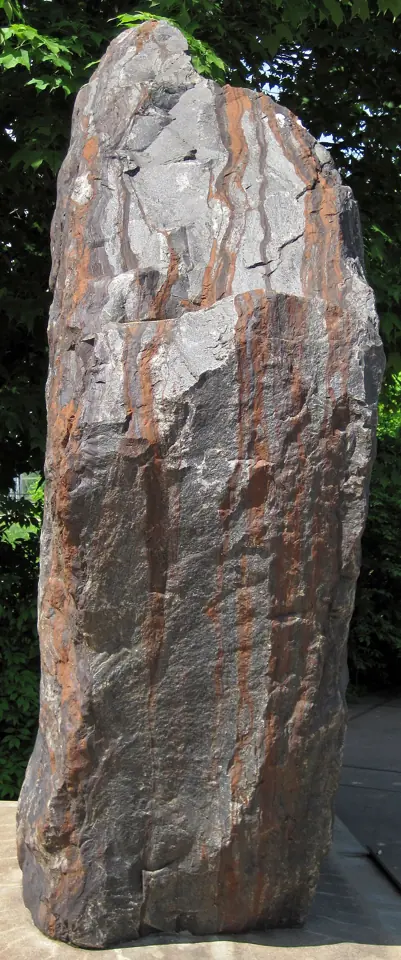
Banded iron formations, the alternating bands of iron and silica that the ocean had deposited for more than a billion years, stopped forming everywhere at once around 1.85 billion years ago.
Banded iron formations are rocks made of alternating bands of iron and silica, which the ocean deposited for more than a billion years. They are the greatest iron deposits in history. Around 1.85 billion years ago, the deposits ceased worldwide. Researchers still weigh two explanations. In the first, the deep sea became euxinic, that is, charged with hydrogen sulfide, a compound of sulfur. Hydrogen sulfide precipitated the iron dissolved in deep water, turning it into a solid: pyrite, a mineral of iron and sulfur. The iron therefore no longer reached the surface, where it would have been oxidised, or combined with oxygen. In the second, the Sudbury impact, the fall of a body from space at that moment, could have mixed the ocean from top to bottom. The mixing would have left deep water in which iron could no longer remain dissolved.
Why it matters
The end of the banded iron formations marks the end of the ferruginous ocean, an ocean rich in dissolved iron. Until then, life had existed in no other environment.
Dating & uncertaintyDisputed
Two explanations remain under consideration. In the first, the deep ocean became sulfidic, another word for euxinic, and iron precipitated as pyrite rather than as oxide, its compound with oxygen. The iron, sulfur and carbon chemistry of the sediments supports the first. In the second, the Sudbury impact mixed the whole water column, the ocean from surface to floor, and left it faintly oxygenated. The coincidence of dates supports the second.
Earth history as one day
14:13:129 h 47 min before midnight
if Earth’s 4.54 billion years were compressed into a single day