LIFE × EVOLUTION × GENETICS
Asgard Archaea: Our Closest Kin
~2 billion years ago
Proterozoic · Paleoproterozoic · Orosirian
Asgard archaea are single-celled organisms without a nucleus, the closest known relatives of complex cells, and the first of them isolated in culture, from deep-sea mud, took twelve years to grow.
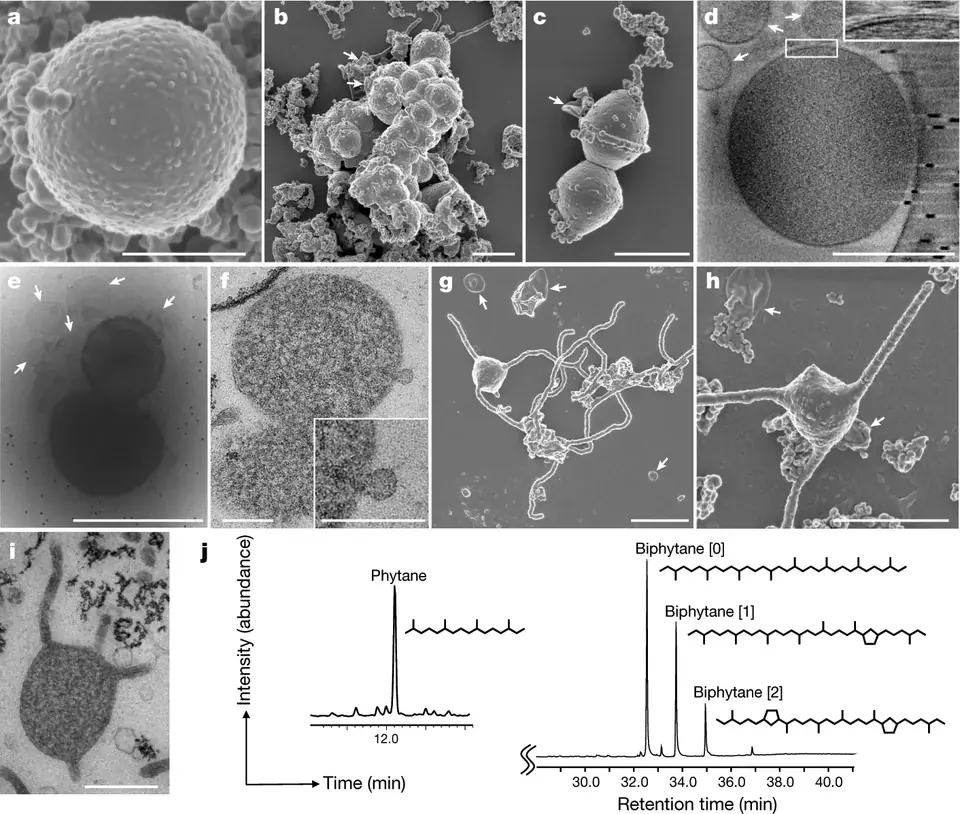
Asgard archaea are a group of organisms without a nucleus, and among such organisms they are the closest known relatives of complex cells. Complex cells have a nucleus, and the organisms made of them are called eukaryotes. Imachi and colleagues (2020) isolated one of the Asgard archaea, Prometheoarchaeum syntrophicum, from deep-sea floor mud after twelve years of culture, because it grows extremely slowly. It is small and fringed with branching arms, and its genome codes for proteins previously thought exclusive to complex cells. Prometheoarchaeum syntrophicum is the leading candidate for the kind of cell that served as host, by incorporating a bacterium, in the merger from which eukaryotes arose.
Why it matters
Living relatives of the cell that incorporated a bacterium, at the origin of eukaryotes, are accessible in present-day sediments. Researchers can therefore study them instead of reconstructing that cell by theory alone.
Dating & uncertainty
The date given for this entry is that of the origin of eukaryotes. Molecular clocks, which date events from genetic differences between species, place it between about 2.3 and 1.6 billion years ago. The Asgard archaea provide no date but a point of comparison: they are the closest living prokaryotic relatives of eukaryotes, prokaryotes being organisms without a nucleus, and a candidate for the host cell.
Earth history as one day
13:25:3810 h 34 min before midnight
if Earth’s 4.54 billion years were compressed into a single day