EARTH
Yarrabubba: the Oldest Crater
~2.229 billion years ago
Proterozoic · Paleoproterozoic · Rhyacian
The Yarrabubba structure, in Western Australia, is the oldest impact crater recognised on Earth, formed when a meteorite struck 2.229 billion years ago.
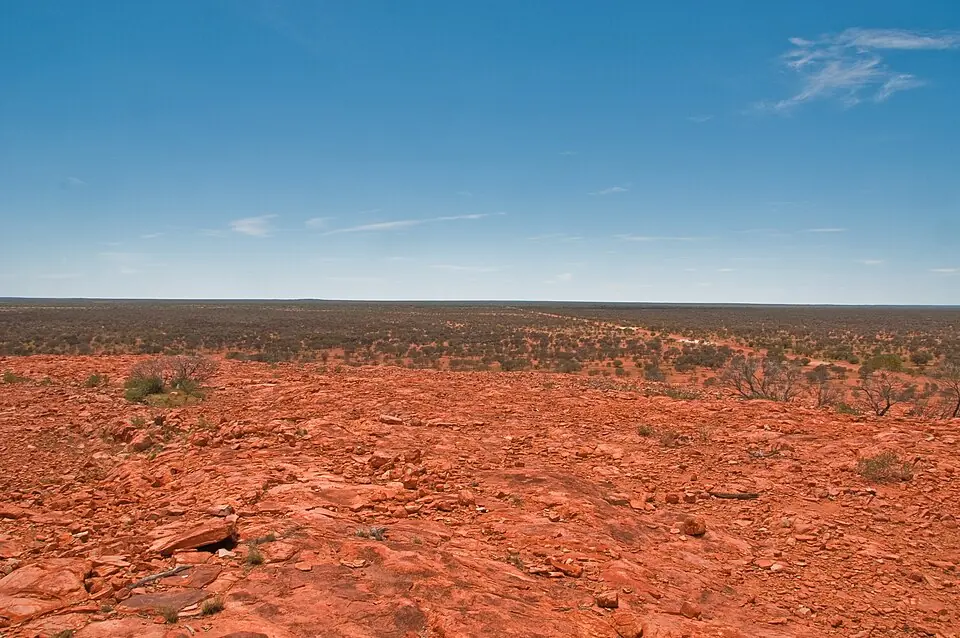
The Yarrabubba structure, in Western Australia, is what remains of an impact crater some seventy kilometres across. Erosion has planed the crater almost flat. Geologists identify it only by shocked crystals in its floor, minerals whose internal structure shows deformation lines that no volcanic or tectonic process produces. The impact is dated to 2.229 billion years ago, which makes Yarrabubba the oldest impact crater yet recognised on Earth. This age extends the record of known impacts back by more than two hundred million years. The impact occurred as the ice ages of the Palaeoproterozoic, an early era of Earth's history, were ending. If the meteorite struck an ice sheet, the water vapour that the impact injected into the atmosphere could have hastened the thaw.
Why it matters
Impacts are ordinarily presented as agents of extinction. The Yarrabubba impact may have brought an ice age to an end.
Dating & uncertainty
Erickson and colleagues (2020) dated monazite, a mineral whose crystals re-formed under the shock of the impact, at 2,229 million years ago, to within 5 million years. Zircon, a second mineral whose dating clock the shock restarted, agrees. Within uncertainty, this date is that of the youngest Palaeoproterozoic glacial deposits, which makes it tempting to link the impact to the end of the ice ages. Only the quantity of water vapour that such an impact would release has been calculated. That the Yarrabubba impact ended a global glaciation has not been demonstrated.
Earth history as one day
12:13:0011 h 47 min before midnight
if Earth’s 4.54 billion years were compressed into a single day