EARTH
Sudbury: the Crater Turned Mine
~1.85 billion years ago
Proterozoic · Paleoproterozoic · Orosirian
The Sudbury basin, in Canada, is an impact structure, the remains of a crater some two hundred kilometres across that formed 1.85 billion years ago, and the rock melted by the impact is now mined for nickel and copper.
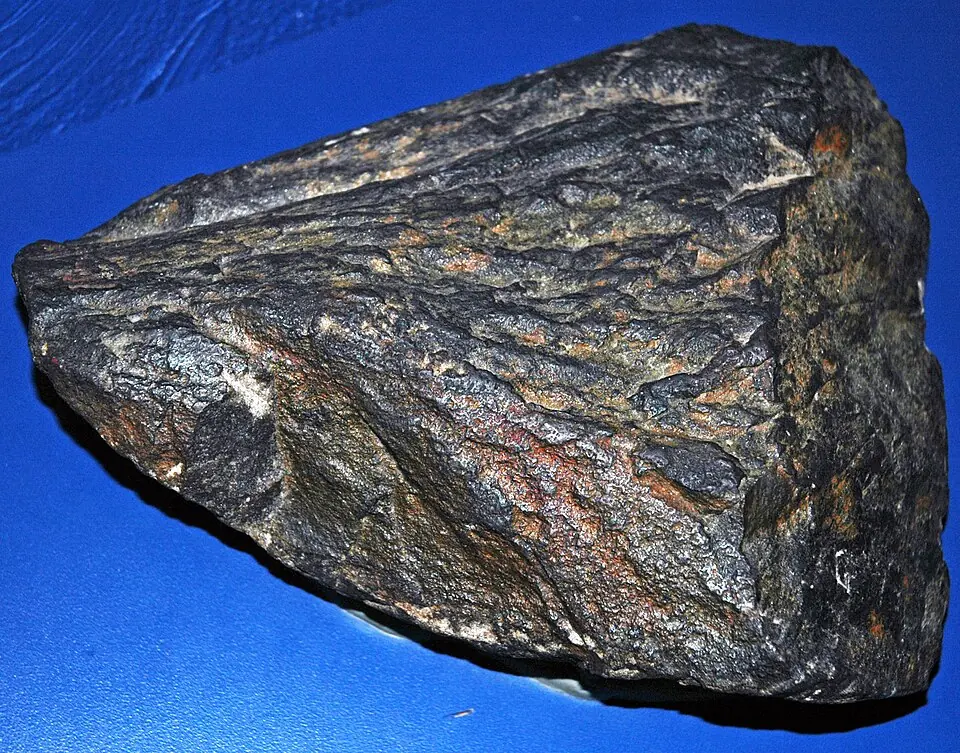
The Sudbury basin, in Canada, is an impact structure, the trace left in the crust by the fall of a body from space. Its crater was originally some two hundred kilometres across. The impact melted the rock that it struck, the target rock, and left a sheet of melt ten thousand cubic kilometres in volume on the crater floor. This melt was a silicate melt, molten rock made mostly of silicon and oxygen. As the sheet cooled, nickel and copper bound to sulfur formed a dense sulfide liquid. This liquid was immiscible with the silicate melt, that is, the two did not mix. The sulfide liquid sank and gathered at the base of the sheet. Geologists call this separation sulfide segregation. That basal layer is now among the richest nickel and copper deposits on Earth, a direct consequence of the impact.
Why it matters
The Sudbury impact left a deposit of nickel and copper that is mined today. The impact also occurred less than a hundred thousand years from the end of the banded iron formations, sedimentary rocks made of alternating iron-rich and silica-rich layers. Slack and Cannon (2009) read this closeness in time as a causal relation.
Dating & uncertainty
The age of the impact is precisely fixed at 1.85 billion years. Wu and colleagues (1995) mapped the buried melt sheet by seismic imaging, a method that pictures buried rock from the echoes of vibrations. The original crater is estimated from this imaging at close to 200 kilometres across. The structure visible today is the deformed, eroded remnant of that crater.
Earth history as one day
14:13:129 h 47 min before midnight
if Earth’s 4.54 billion years were compressed into a single day