LIFE × EVOLUTION
Sauropods: the Largest Land Animals
~190 to 145 million years ago
Phanerozoic · Mesozoic · Jurassic
Sauropods, long-necked herbivorous dinosaurs, reached ten times the mass of the largest land mammal through several traits, each of which made the next possible, between 190 and 145 million years ago.
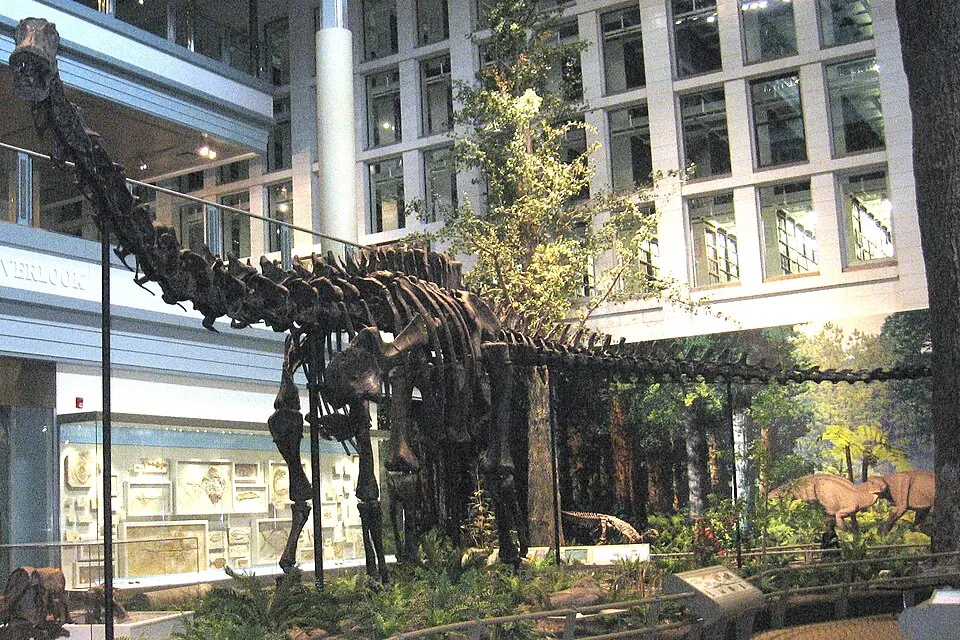
Sauropods were herbivorous dinosaurs with a very long neck, and they reached ten times the mass of the largest land mammal. Several traits explain this mass, and each made the next possible. The very long neck reached food that no other herbivore could take. The neck could be long only because the head remained small, and the head could remain small because sauropods did not chew. Sauropods had a lung of the type found in birds, in which air passes in one direction. The air is stored in air sacs, extensions of the lung that invade the bones. The air sacs lightened the skeleton and may have removed heat from a body too large to cool itself by its surface. Sauropods also grew rapidly and laid many small eggs.
Why it matters
Mammals do not attain the masses of sauropods. The reasons lie in the biology of mammals and not in the state of the planet. A mammal chews, so it requires a heavy head. It carries its young in its body before birth, so it cannot produce them by the dozen. The same reasoning applies to the other terrestrial herbivores. Ectothermic reptiles, whose body temperature depends on their surroundings, are the smallest of them: their metabolism is too slow to bring a large body to breeding age.
Dating & uncertainty
Several sauropod lineages exceeded fifty tonnes independently, at different periods. The giants of the Jurassic came first, and the titanosaurs, a group of sauropods of the Cretaceous, the following period, equalled or exceeded them. Gigantism therefore has no single date. Nothing indicates that the world of the Mesozoic, the era that includes the Jurassic and the Cretaceous, had more food resources or different physical conditions, so the explanation must be biological.
Earth history as one day
22:59:441 h before midnight
if Earth’s 4.54 billion years were compressed into a single day