LIFE
The First Dinosaurs
~233–230 million years ago
Phanerozoic · Mesozoic · Triassic
The oldest animals universally accepted as dinosaurs, about 233 to 230 million years old, were small, fast bipeds the size of a large dog, found in Argentina and Brazil.
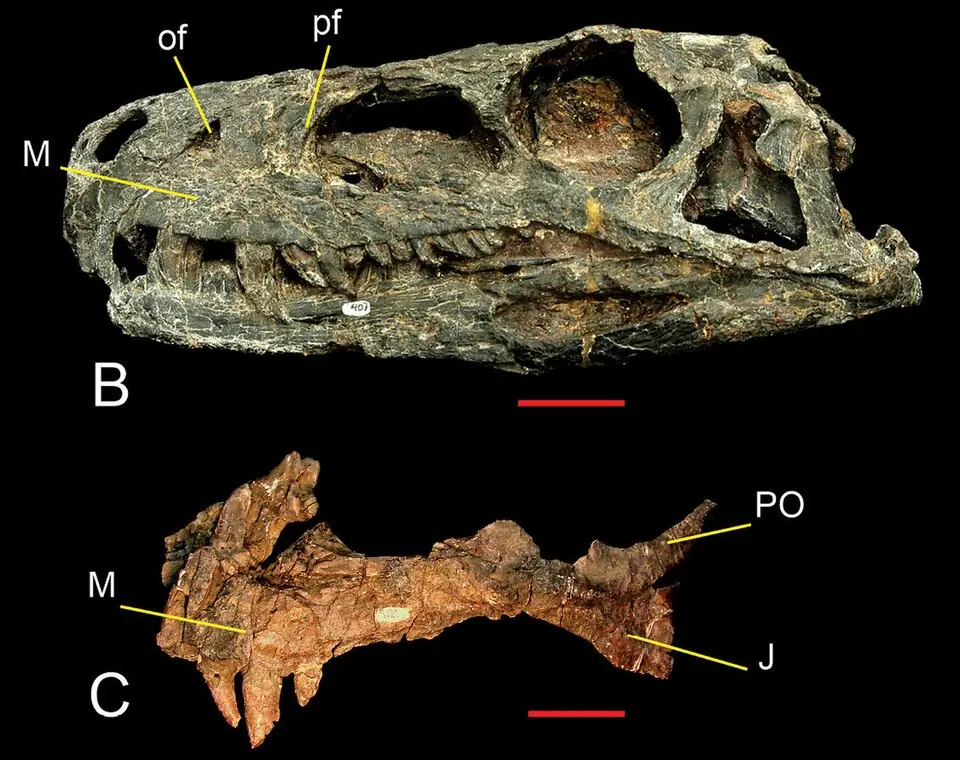
The first dinosaurs are the oldest animals that all specialists accept as dinosaurs. They were small, bipedal and fast, and they lived in what is now Argentina and Brazil. Two of them, Herrerasaurus and Eoraptor, were about the size of a large dog. Argentina and Brazil then belonged to Pangaea, the supercontinent that joined all the continents. In that region of Pangaea, the first dinosaurs were already the principal carnivores and the small herbivores. Their anatomy gives no indication of the later expansion of the group.
Why it matters
According to the usual account, dinosaurs expanded into space vacated by an extinction. In Argentina, however, the succession of rock layers is dated and divided into faunal zones, intervals each defined by its own animals. There the herbivores in place disappear lineage by lineage, and dinosaur diversity does not rise as these herbivores disappear. Through their first thirty million years, dinosaurs were probably confined by climate rather than by competition. They are absent from the tropics of Pangaea. Wherever the latitude suited them, in Africa as in South America, researchers find the same fauna.
Dating & uncertainty
Researchers dated volcanic ash by the uranium-lead method, which gives an age from the decay of uranium into lead. The ash comes from the Ischigualasto basin, in Argentina, and from the Santa Maria formation, in Brazil, a formation being a named body of rock layers. The ages place the first dinosaurs between 233 and 230 million years ago, which makes their origin one of the most precisely dated on this timeline. The location of that origin is less clear. African rocks of the same age also contain dinosaurs. The scarcity of early dinosaurs outside a narrow band of latitudes may reflect the distribution of climates rather than a point of origin.
Earth history as one day
22:46:431 h 13 min before midnight
if Earth’s 4.54 billion years were compressed into a single day