LIFE × EVOLUTION
The Origin of Eusociality
~200 to 100 million years ago
Phanerozoic · Mesozoic · Jurassic
Eusociality, in which some members of a colony give up reproduction to raise the offspring of another member, arose first in termites and then independently in ants, bees and wasps, between 200 and 100 million years ago.
Eusociality is the organisation of a colony in which some individuals forgo reproduction to raise the offspring of another, so that the whole colony reproduces as a single unit. It arose first in termites, then independently in ants, bees and wasps. Taniguchi and colleagues (2024) describe ants preserved in 100-million-year-old amber, a fossil resin. These ants already have antennal sensilla, the sensory structures of the antennae. Ants use the sensilla to detect alarm pheromones, the chemical signals that warn of danger, and to distinguish a nestmate from a stranger. No colony can operate without these two signals.
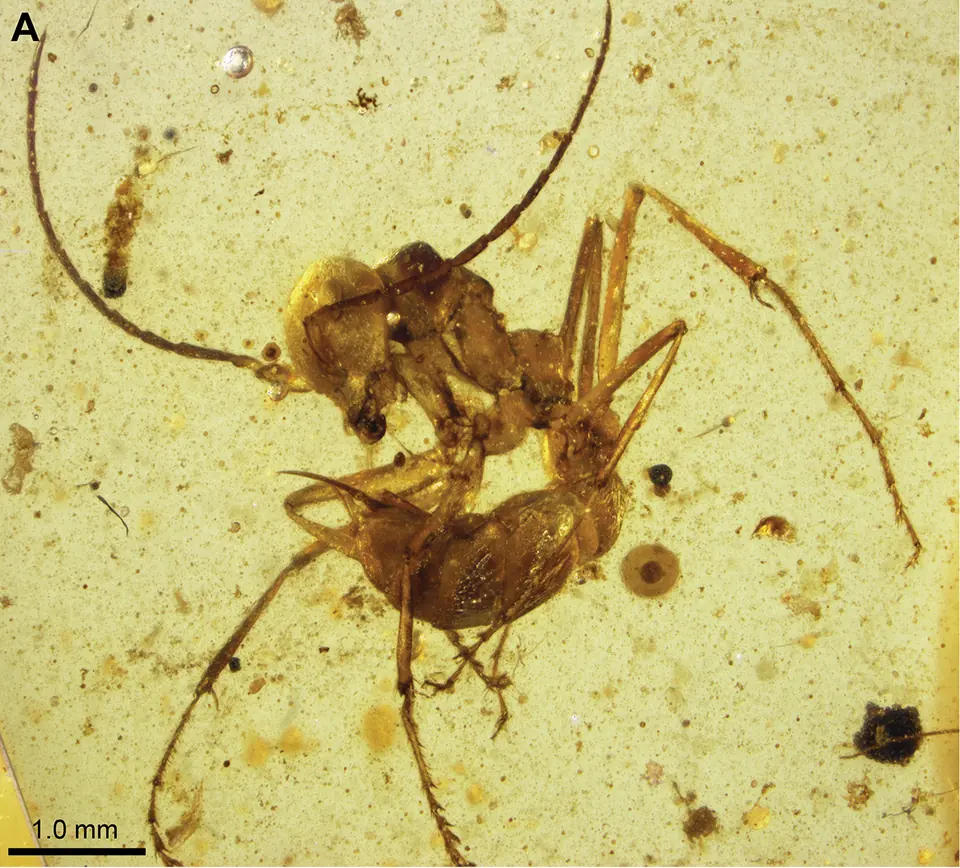
Why it matters
The sequencing of ant genomes indicates how rapidly eusociality became established in ants. Romiguier and colleagues (2022) identified the three gene functions under the strongest natural selection at the time the main ant lineage appeared. These functions relate to the differences between castes, the categories of individuals in a colony such as queens and workers, to the sterility of workers and to the longevity of queens. Complex eusociality rests on these three characters. Its molecular foundations appear to have formed in under twenty million years.
Dating & uncertainty
Jouault and colleagues (2021) place termite eusociality around 200 million years ago. They built a family tree from anatomy and calibrated it, that is, dated its branches, with the fossils the tree contains. They present this age as a possibility and not as an established value. Ants appear later. Ants preserved in amber 100 million years ago already have the antennal sensilla used for colony recognition.
Earth history as one day
22:56:331 h 3 min before midnight
if Earth’s 4.54 billion years were compressed into a single day