EVOLUTION × LIFE
Archaeopteryx and the First Birds
~150 million years ago
Phanerozoic · Mesozoic · Jurassic
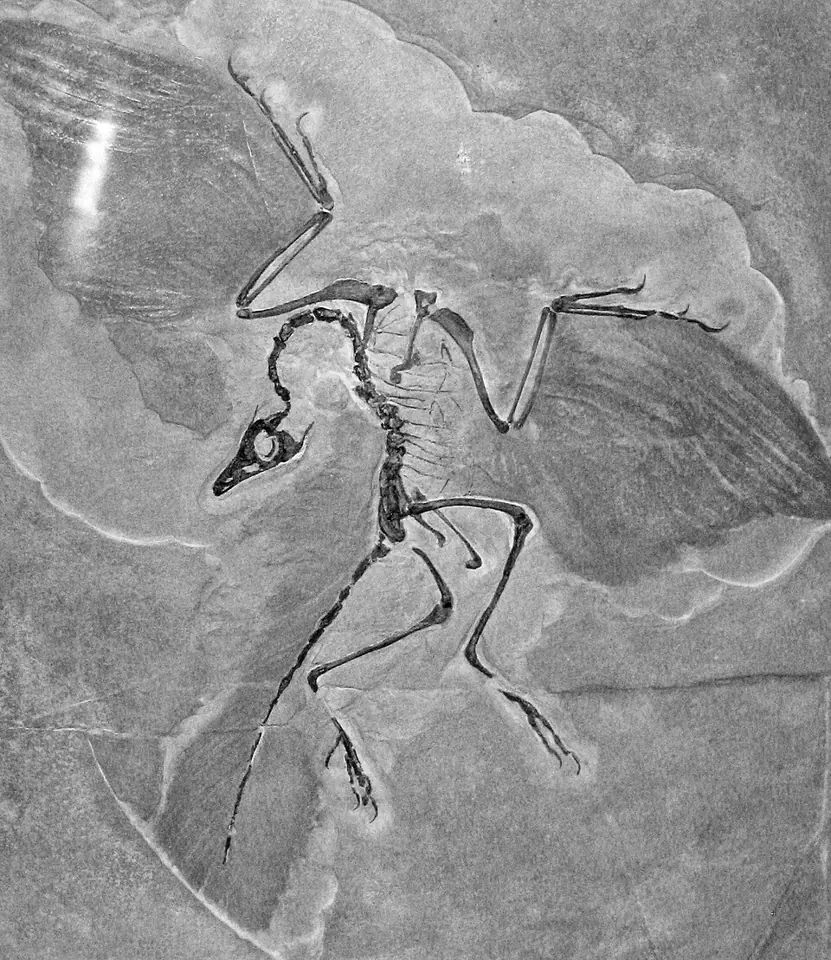
The first birds, Archaeopteryx among them, were already varied in the Late Jurassic, about 150 million years ago, and their feathers, wishbone and hollow bones had appeared in small carnivorous dinosaurs well before flight.
Archaeopteryx is the animal of the Late Jurassic, with a long bony tail, that is traditionally taken as the first bird. Feathers, hollow bones and the furcula had all appeared in small carnivorous dinosaurs well before flight. The furcula, commonly called the wishbone, is the bone formed by the fusion of the two clavicles, or collarbones. Birds of the Late Jurassic were already diverse. In a Chinese deposit of that age, Chen and colleagues (2025) describe a short-tailed bird whose shoulder and hip are already close to those of a modern bird, while its hand is still that of a dinosaur. The same deposit contained a furcula from a lineage still more derived, that is, further from the ancestral form, than the short-tailed bird.
Why it matters
The traits of birds appeared one by one, in irregular order and at different rates, so the point at which an animal is called a bird is a convention. One branch survived the impact that ended the Cretaceous, the period that followed the Jurassic. Some ten thousand species of that branch are alive today.
Dating & uncertainty
The body plan of birds assembled element by element over several tens of millions of years within the theropods, the group of dinosaurs that includes the small carnivorous ones. Designating a first bird is therefore a convention. Archaeopteryx, around 150 million years ago, is the traditional marker. One analysis, by Xu and colleagues (2011), places Archaeopteryx outside birds, with weak statistical support. Short-tailed forms are now known from the same interval as Archaeopteryx.
Earth history as one day
23:12:2547 min 35 s before midnight
if Earth’s 4.54 billion years were compressed into a single day